Where there are no lions, wolves rule, and where wolves are absent, jackals and foxes can spread. Outwardly they are very similar and were not clearly distinguished linguistically in the Bible.
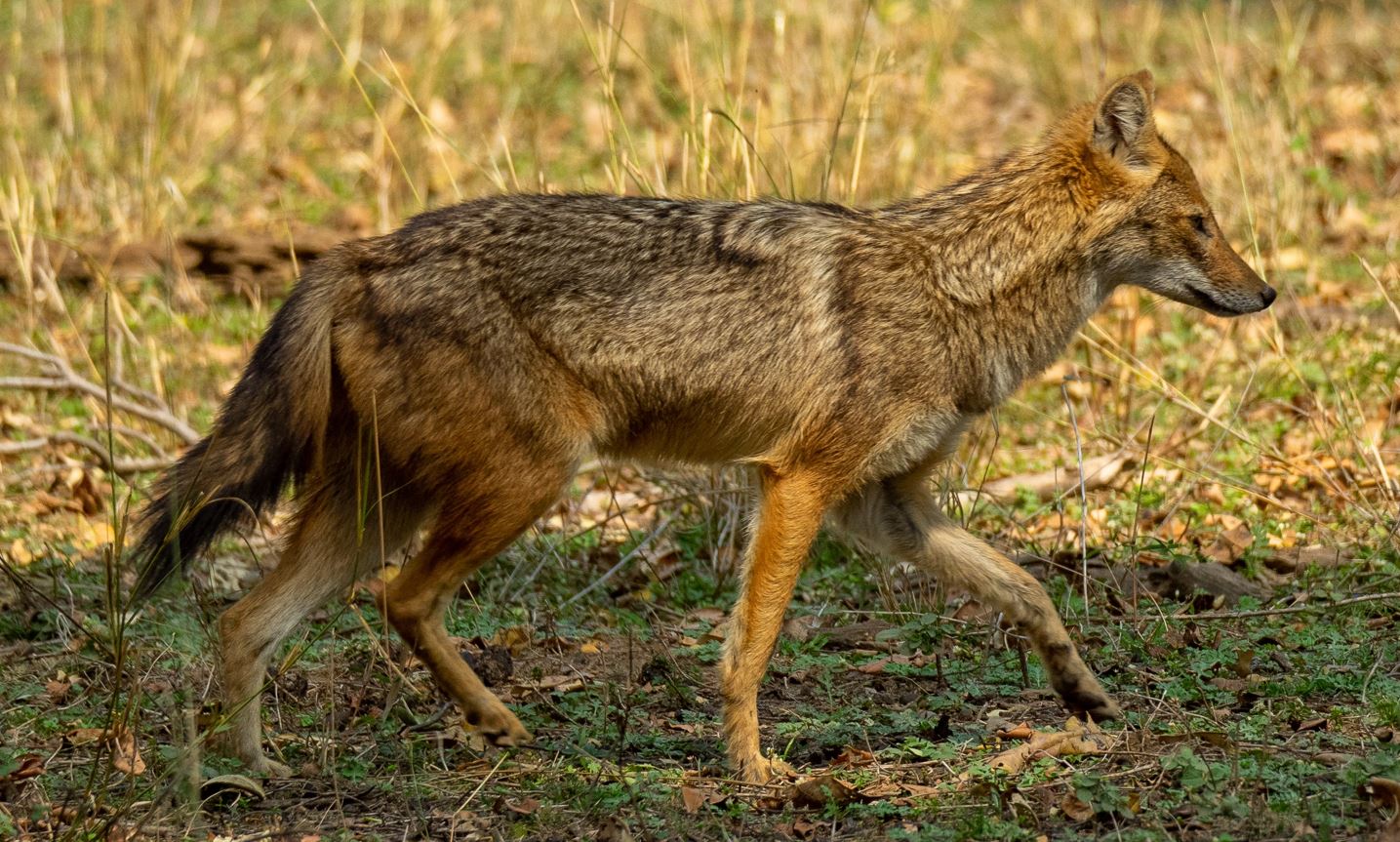
The golden jackal (Canis aureus) is a close relative of wolves and dogs, with which it can also interbreed, although in appearance it would more readily be classified among the foxes. Its outward appearance can vary greatly, so that it was formerly divided into twelve subspecies, of which the subspecies of the Syrian golden jackal (Canis aureus syriacus) lives in Israel. A genetic study of the regional differences, however, showed that the subspecies differ so marginally that this subdivision was abandoned again. Incidentally, migrating golden jackals from the Balkans can occasionally even be detected in the wilds of Germany by means of scat samples!
The pointed snout, the long tail, and the elongated body shape earned the jackal its Hebrew name tannin (14×), with the meaning «elongated». This expression is also used for sea monsters (possibly dinosaurs) and snakes, but the textual context makes clear what is meant in each case. It is interesting, however, that the LXX shows a tendency toward dramatization in pronouncements of judgment, which is evident, among other things, in the fact that the tannin become drakontas (dragons, Jer 9:10; Lam 4:3; Mic 1:8) or seirenes (sirens, mythological fabulous beings, Job 30:29; Isa 13:22; 34:13; 43:20). This seems very far-fetched. Only in the name Ajin-haTannin (Neh 2:13) can one puzzle over whether it should better be translated «Spring of the Jackals» or «Dragon Spring». Another designation for jackals is schu’al (6×). This word is mostly assigned to the fox in German translations and is rendered in the LXX consistently as alopex.
Remarkable is the long dependence of jackal pups on their parents. While dogs are often fairly independent already one month after birth and become capable of reproduction at half a year, young jackals depend on their parents for half a year and reach full sexual maturity only at twenty months. The mothers nurse the pups for about eight weeks. If food scarcity follows, milk production declines only gradually and the offspring continue to receive individual rations.
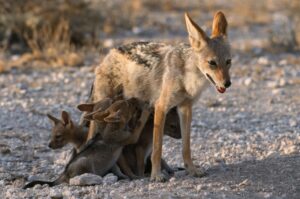
This remarkable behavior is referred to in a biblical comparison: «Even jackals offer their breasts to nurse their young, but my people have become heartless like ostriches in the desert» (Lam 4:3). While female jackals use up their last reserves in order to keep their offspring alive, Lamentations describes a few verses later a situation in which the hard-hearted women in Israel try to survive at the expense of their children: „With their own hands compassionate women have cooked their own children, who became their food when my people were destroyed» (Lam 4:10, cf. Lam 2:20). We also read of this dramatic scene during the siege of Samaria: «Give up your son so we may eat him today, and tomorrow we’ll eat my son. So we cooked my son and ate him. The next day I said to her, ‘Give up your son so we may eat him,’ but she had hidden him» (2Kgs 6:28-29). It is worth reading this account in context, for it also strikingly reflects our own time. In the city there is distress and despair; one relies on the protection of its walls, continues to feed the last warhorses despite famine, lives without hope, and sacrifices one’s own children – selfish like the female ostriches that do not care for their young. Even wild animals like jackals show more cohesion and willingness to sacrifice. Yet salvation is already present; outside the gates supplies and riches are waiting only to be taken into possession. God has opened the windows of heaven; no one needs to starve – «This is a day of good news» (2Kgs 7:9). All that is needed are messengers who proclaim this message and listeners who believe it, dare to step out of deceptive security, and allow themselves to be set free.
Jackals are very shy, keep as far away from settlements as possible, and avoid encounters with humans. Like some other desert animals, they are mentioned to emphasize the desolation and uninhabitability of destroyed and devastated regions: «Hazor will become a haunt of jackals, a desolate place forever. No one will live there; no people will dwell in it» (Jer 49:33); «Thorns will overrun her citadels, nettles and brambles her strongholds. She will become a haunt for jackals, a home for owls» (Isa 34:13) – to name just two examples. In Jeremiah 14:1–9 a terrible drought disaster in the southern kingdom of Judah is described. The hostility to life of the parched land is shown in the fact that even the typical desert dwellers perish: «Wild donkeys stand on the barren heights and pant like jackals; their eyes fail for lack of food» (Jer 14:6). Even though the jackal is well adapted to life in barren semi-deserts, it is easier even for it when the landscape turns green and blossoms after the rainy season. Amid all the references in connection with God’s judgment over lands and peoples, there is also a hopeful outlook for the jackals: «The wild animals honor me, the jackals and the owls, because I provide water in the wilderness and streams in the wasteland, to give drink to my people, my chosen» (Isa 43:20).
Sources:
Hahn, R.: Wilde Hunde auf der Balkan-Route. Frankfurter Allgemeine, 15 January 2021; https://www.faz.net/aktuell/wissen/leben-gene/goldschakale-in-deutschland-gesichtet-17147295.html?service=printPreview
Macdonald, D. W.: The flexible social system of the golden jackal, Canis aureus. Behavioral Ecology and Sociobiology 1979; 5:17–38; doi: 10.1007/BF00302692
Zootierliste. Accessed on 21 July 2023: https://www.zootierliste.de/index.php?klasse=1&ordnung=115&familie=11509&art=1120122
Image Credits:
Wikipedia: Golden Jackal / Mattb13
Other licenses: Title Golden Jackal / Shutterstock ID_512846251 // Vladimir Kogan Michael // Black-backed jackal with young / Alamy ID_B95FEK / Ben Dilley