The members of the order Columbiformes share so many characteristics that it contains only one large family: the pigeons and doves (Columbidae). Even so, they display a richness of species whose diversity of forms Charles Darwin—himself an enthusiastic pigeon breeder—cited as a prime example of natural variation and selective breeding.
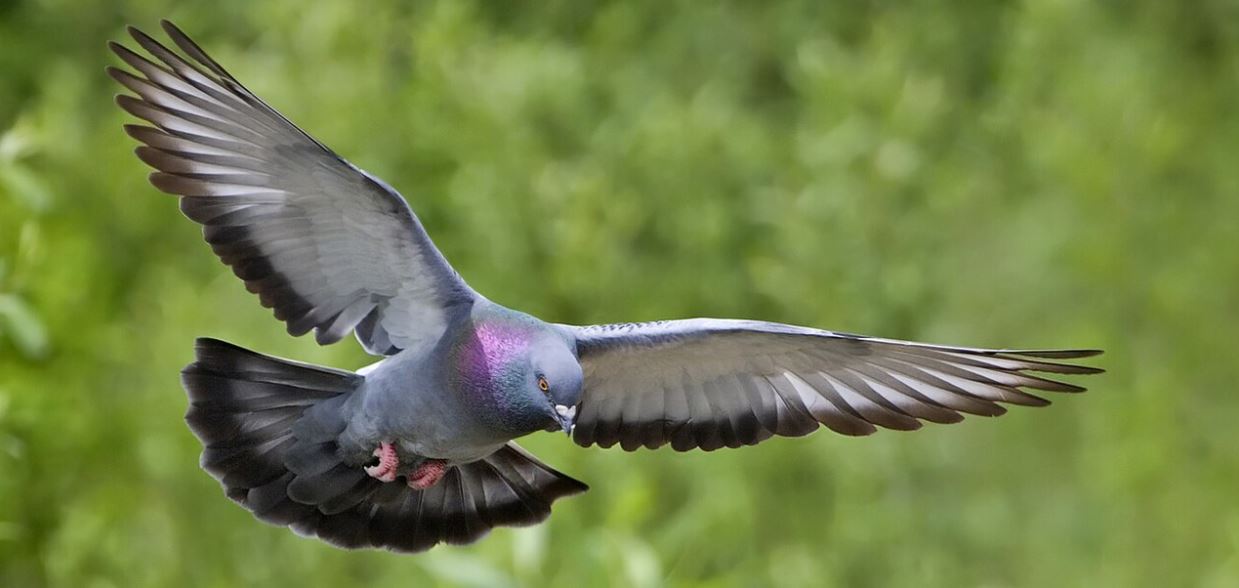
The pigeons and doves mentioned in the Bible (jona and peristera) are mainly rock doves (Columba livia), from which domestic pigeons and carrier pigeons were also bred. Turtle doves (Streptopelia turtur) are also mentioned; their species name turtur, just like the Hebrew word tor and the Greek trygon, is an onomatopoetic description of their rolling «turr-turr» call. In addition, Israel today—and probably in earlier times as well—is home to the Eurasian collared dove (Streptopelia decaocto), the laughing dove (Spilopelia senegalensis), the common wood pigeon (Columba palumbus), and the stock dove (Columba oenas). A closer look at these birds makes it clear why, in the imagery of the Bible, they are a symbol of purity, peace, fertility, and «simplicity.»
The nesting site of pigeons and doves—one can hardly call it a «nest»—is very simply constructed and often consists of only a few twigs that keep the eggs from rolling away. If the surface is uneven enough, they often dispense with nesting material altogether. This offers the young nestlings hardly any protection, but in heat, cold, or wet weather they are lovingly «brooded»: completely hidden under the parents’ wings and nestled into the soft, dry breast feathers, even the most unpleasant weather cannot harm them.

Although pigeons and doves are not mammals and have neither mammary glands nor nipples, teats, or anything similar, they are nevertheless able, in a unique way, to «nurse» their young. During the breeding season, the mucous membrane lining the crop sac of their esophagus begins to grow and slough off in thick plaques. From this bodily substance a secretion rich in fat and protein is produced—an extremely nutritious, cream-cheese-like mass known as pigeon milk or crop milk. Regurgitated in small portions, it is dripped into the wide-open throats of the hungry young and produces rapid growth. This complete food contains everything the little ones need. During the first few days, they receive nothing else. Whereas milk production in mammals is exclusively the mother’s affair, this «power food» is secreted and fed not only by the female pigeon but also by the male.

Although the dove is a fertility symbol in many cultures, one rarely finds more than two eggs in its clutch. Closer observation reveals the secret of its rapid reproduction: because the minimal nest construction requires hardly any effort and is completed in no time, the parents build another nesting site near their «primary residence.» The female lays two new eggs there while continuing to care for her first nestlings. Thanks to the special «doping» of crop milk, they grow so quickly that after only two weeks they can be left alone and need to be fed only two or three times a day. At three weeks they already leave the nest for short excursions; after one month they are fully developed and independent. Through this nested pattern of parallel broods, a diligent pigeon pair can raise up to six clutches in one season.
The grown young birds remain near their parents and continue to feel that they belong to the ever-growing family group. Only much later, when they choose their own mate—to whom they remain faithful for life—do they live independently.
Two people newly in love are colloquially called «turtle doves». To the human observer, the courtship, bonding, and mating behavior of all pigeon and dove species appears exceptionally tender and devoted. A pair can sit peacefully together for hours, «preening» each other with their beaks, cooing in duet, and rubbing their little heads against each other. It is therefore no surprise that the dove is also a symbol of happiness and love. In Russian, golubushka—«little dove»—is a popular term of endearment; many other languages refer to the same image as well. And already in the oldest «love song», the beloved is called jona-ti—«my dove» (Song 2:14; 5:2; 6:9).

Snow-white breeds are rented out as «wedding doves» and released as a large flock. When their lofts are opened at the same moment, they rise like a swirling cloud, circle once over the wedding party in an «orientation round», and then begin the flight home. The beautiful sight expresses what every married couple should be wished: purity, love, lifelong faithfulness, happiness, fertility, peace, and a clear course on which they reach the goal together.
A special characteristic of the dove is already evident in its earliest mention in the Bible (see Gen 8): When the waters of the Flood slowly began to recede from the earth, Noah first sent out a raven as a scout. Although it is a highly intelligent bird, it failed in its mission and, after fruitless circuits, kept landing on the roof of the ark, without, however, giving up its newfound freedom. Noah then chose the dove as a scout. It too returned unsuccessfully from its first flight, but it trustingly landed on his hand to reenter the ark. A week later, on the next reconnaissance flight, it searched as long as daylight allowed and succeeded: toward evening it returned with an olive leaf in its beak—the first tangible sign that the catastrophic judgment of the Flood was over. Through this event, the dove with the olive leaf became a symbol of peace and reconciliation. On its next reconnaissance flight it found a dry place and did not return. Later, the raven also flew away.

The Holy Spirit appears in the form of a dove coming upon the Lord Jesus after He had been baptized by John in the Jordan (Mt 3:16; Mk 1:10; Lk 3:22; Joh 1:32). The Bible first speaks of the Spirit of God in the creation account, where He hovers over the waters (Gen 1:2). The same verb is also found in the description of the eagle that vigilantly flies over its young (Deut 32:11). Just as the dove on the flooded earth found «no resting place for the sole of her foot» (Gen 8:9), so the Holy Spirit also had to «wait» until, in Jesus, He found a man who was perfectly pure and sinless, so that He could remain upon Him permanently (Joh 1:32). Besides the deeper spiritual meaning of the scene in Genesis 8—that it can be understood as visible proof of the successful cleansing of the earth when the dove, as a clean bird, finds a «resting place» upon it—two further special features can be discovered in the account.
The first is the highly developed sense of direction to which the pigeon owes its astonishing homing ability. Already the ancient Babylonians made use of this ability by operating pigeon post stations, and Phoenician sailors took pigeons aboard their ships. In this way they could not only announce their arrival to their partners in the harbor in good time, but at times also correct their course, for the pigeon always flies home by the most direct route. In a vivid comparison, the return of the people of Israel from worldwide dispersion to the land of their fathers is likened to this: «Who are these that fly like a cloud, and like doves to their dovecotes?» (Isa 60:8).
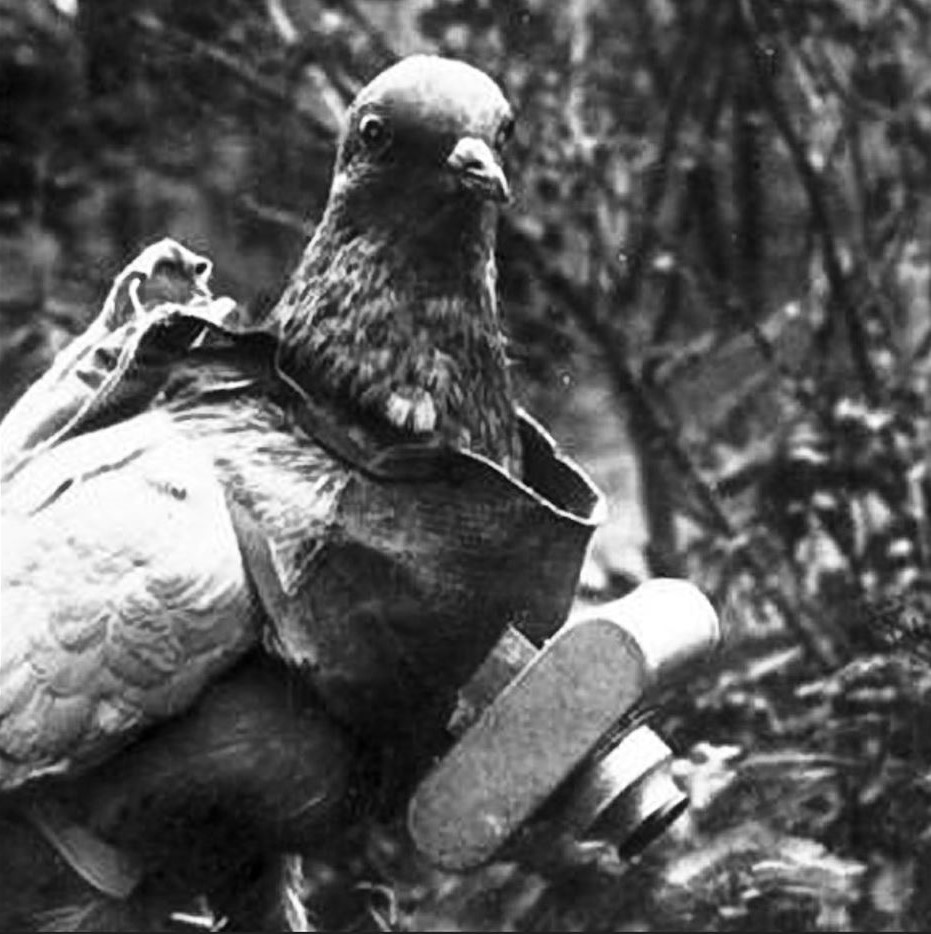
In countless military conflicts, their courier services played an important role. They carried the news of the victory at Waterloo to London in 1815, were fitted with cameras and used for aerial reconnaissance in the First World War, and in the Second World War were dropped on small parachutes over scattered troop units in order to obtain messages. The Swiss Army did not disband its carrier pigeon service until 1996. China still maintains a pigeon army of 10,000 birds today.
Winkie (service name NEHU.40.NS.1) was a blue checkered carrier pigeon trained during World War II by the National Pigeon Service for duty in the British Army. She was aboard a torpedo bomber (Bristol Type 152 Beaufort) when it crashed into the North Sea on February 23, 1942, after being severely damaged by enemy fire during a mission over Norway. Struggling for survival in the icy waters, the crew remembered the pigeon they had on board. It seemed like a long shot, but she was the only chance to call for help, since there had been no time before the emergency water landing to send a radio message with the exact position.
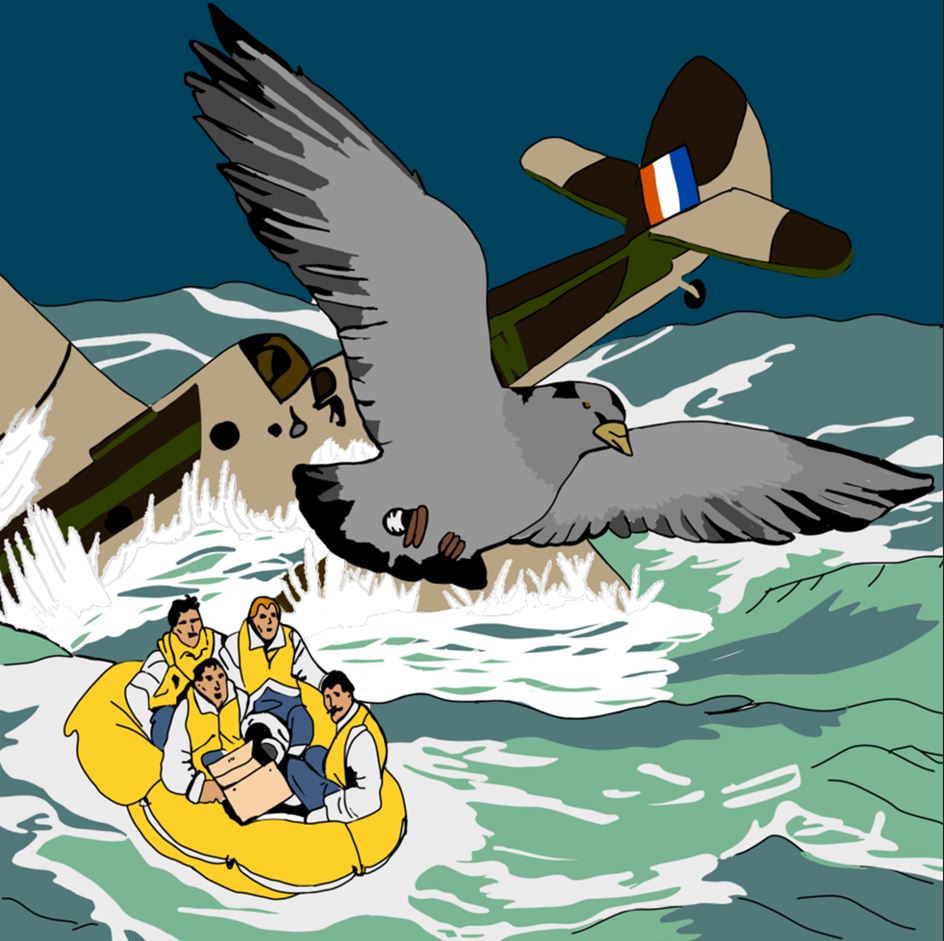
The released Winkie flew 190 km to Broughty Ferry, her home loft, where her owner, George Ross, discovered the exhausted bird. He alerted the RAF airbase at Leuchars in Fife, and a search and rescue operation was launched. Based on the time difference between the crash landing and the pigeon’s arrival at the loft, as well as the wind direction, the RAF was able to determine the approximate location of the downed aircraft, and within fifteen minutes a rescue vessel was dispatched. On December 2, 1943, Winkie was awarded the Dickin Medal for her service. The rescued crew later hosted a dinner in honor of the pigeon, who basked in her cage while the officers toasted her. When Winkie died, Ross donated her and her Dickin Medal to the Dundee Art Gallery, where she can still be admired today.
It may be hard to believe, but even in the digital age, the good old carrier pigeon can sometimes be a beak-length ahead of modern communication technology. A South African company compared the data transmission speed of its web server with that of a winged messenger carrying a 32 GB USB stick, which needed two hours for a straight-line distance of 63 kilometers plus download at the destination. This corresponds to a bandwidth of just over 4 Mbit/s—clearly outperforming the online connection. Admittedly, this competition took place in 2009 and is now several years in the past, but since then not only have bandwidths increased, but the capacities of USB sticks have grown enormously. Although the pigeon would fall behind over greater distances, it would still win the race over medium distances in many parts of the world today.
Since domestic pigeons are very undemanding guests and can be kept with minimal cost and space requirements, they are considered ideal pets even in densely populated areas. In Germany’s Ruhr region, for example, the tower-like pigeon lofts on the row houses of mining settlements soon shaped the cityscape. Carrier pigeon breeding clubs sprang up like mushrooms, and the cooing upper-floor tenants—affectionately called «the working man’s racehorses»—were entered into large-scale competitions against each other. Transported to distant locations in a special truck, the «cabin express,» and released simultaneously in a mass start, the prize-winning champions fly back to their home lofts at average speeds of up to 100 kilometers per hour. Their arrival times are recorded to the second in a sealed timing clock, tamper-proof and precisely documented.

Although pigeons have been kept since ancient times as utility, breeding, and, in more recent times, experimental animals—and alongside domestic chickens are among the best-studied birds—the mystery of their phenomenal sense of orientation remains largely unsolved.
The second specialty of the pigeon is its phenomenal visual perception. This is not just about visual acuity—many birds have extremely sharp eyesight. In this respect, the pigeon ranks in the upper middle range and could still read a newspaper at a distance of 30 meters. By comparison, its archenemy, the peregrine falcon—the record scout among all living beings, capable of spotting a flying pigeon from a distance of eight kilometers (!) as its preferred prey—could read the same newspaper even from 100 meters away. The superiority of pigeon vision, however, is based on many additional factors. Their retina contains a high density of four different types of color receptors (humans have three), enabling them to distinguish finer gradations of color and cover a broader spectrum, including ultraviolet light. They can also perceive the vibration plane of polarized light, allowing them to «filter out» reflections from their visual field and orient themselves by sunlight without having to see the sun directly. Their eyes, positioned on the sides of the head, together cover a field of vision of 340°, so that they need only minimal head movement to take in the entire panorama.
The real highlight is the function of their downstream image processing. The images from both eyes, which overlap only by about one-eighth, are compared with each other. Similar structures—such as ground surfaces covered with stones, sand, grass, or pine needles, water waves, clouds, or the canopy of a forest—cancel each other out. Deviating objects, on the other hand, are highlighted and amplified, especially if they match a preprogrammed search pattern.
They primarily need this ability for their favorite activity: finding scattered grains and pecking them up in rapid succession. In addition, they are (usually) able to detect the approaching peregrine falcon— not only the sharpest-sighted but also the fastest animal in creation—in time and bring themselves to safety.
However, the pigeon’s visual perception system is far more powerful—here we are dealing with hardware of enormous capacity, ready to be fed with image and structural information. Science is only just beginning to discover and make use of this resource.
Pigeons can be trained to «store» arbitrary images and later recognize them again in random sequences. The «upload» process is extremely simple: the pigeon is shown a color image, then the screen turns black, and next two images appear side by side—the one previously shown and a new, unfamiliar image, randomly arranged, sometimes on the right, sometimes on the left. By pecking at the correct image, it confirms recognition. Remarkably, this memory is transferred into long-term storage, and from then on the pigeon «knows» the image for the rest of its life. In this way, up to 1,200 images have been «mixed» into its memory, and the trained animals were still able to recognize them even after three years. The images can later be presented individually, in pairs, or as a whole gallery—the pigeon picks out its candidates and ignores the «distractor» images, even if they look similar.
In another experiment, pigeons were trained to memorize a person and then recognize that individual in photographs containing many people. While the «memory» task required exact recognition of specific images, here the goal was to learn the typical features of «Mr. X» as a flexible search pattern. Pigeons prove to be true master detectives in this respect: even when profile, facial expression, posture, hairstyle, or clothing vary considerably, the target person is identified with great reliability.
Hundreds of research papers have now been published, yet new discoveries keep emerging. Pigeons distinguish images of pigeons from those of all other birds; they are capable of assigning an image they have never seen before to a learned category (tree, flower, fish, dog, car, airplane, baby …); they can be trained to distinguish a Van Gogh from a Chagall, to assign paintings to an artistic period, and to evaluate children’s drawings as «good or bad» (in the sense of «realistic»). When it comes to typical classification tasks («Which image does not belong in this series?»), they would pass any aptitude test with flying colors. Even when only a hand or a foot is visible and the rest of a person is concealed, they have no difficulty determining whether a picture contains a human being or not.
The pigeon’s visual perception and discrimination abilities practically cry out to be integrated into technical processes—and indeed, there have already been some attempts. Its small «high-performance computer» is capable of aligning the images from both eyes with such precision that, in the 1970s, pigeons were used to monitor production processes. With one eye observing the predefined standard pattern and the other the manufactured workpiece, they detected deviations in the range of hundredths of a millimeter and, by pecking a button, declared defective goods as rejects.
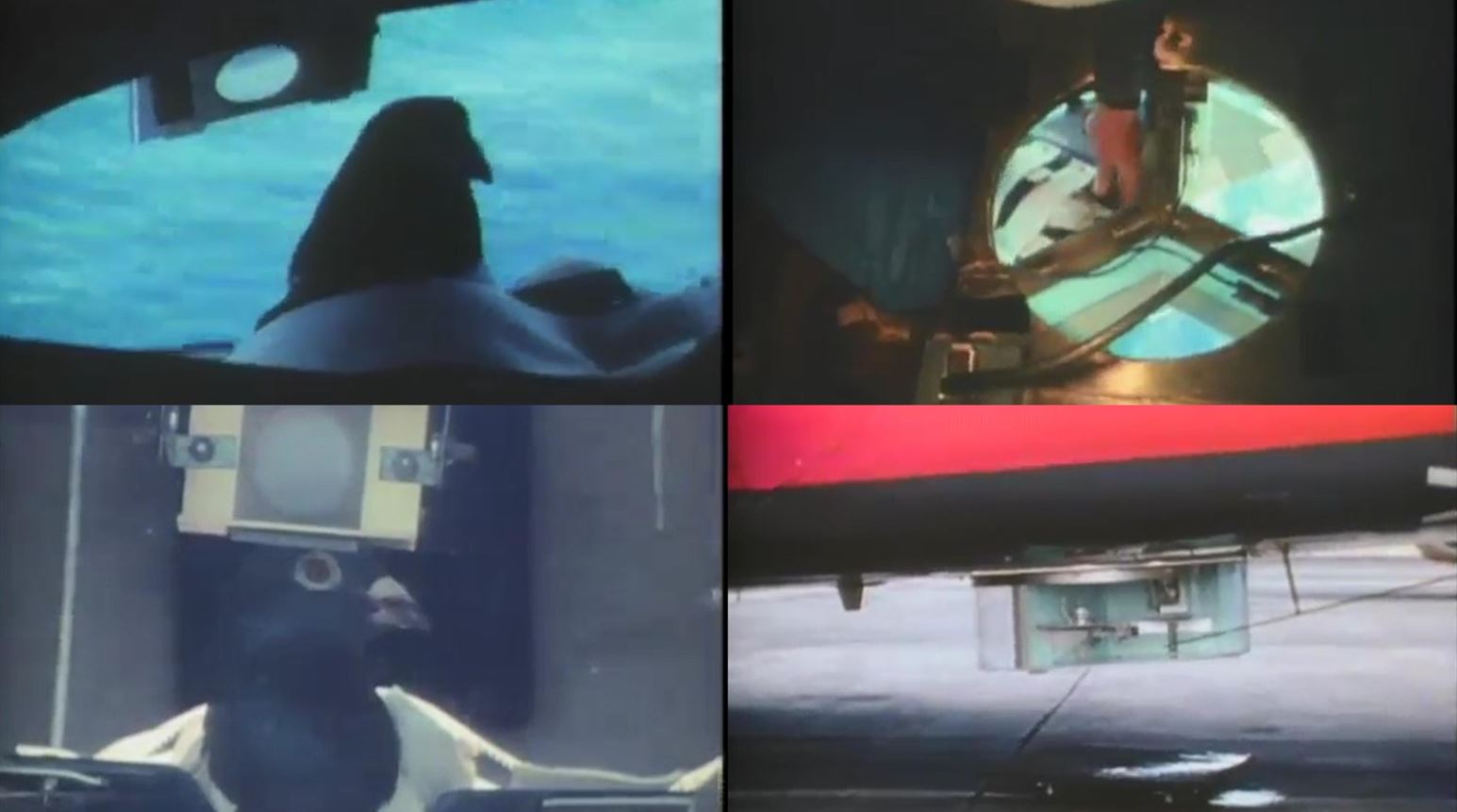
Beneath the helicopter, three pigeons in a glass dome patiently scan for objects in distress orange. A sighting is reported by pecking a signal button, and an indicator light shows the pilot which direction to fly.
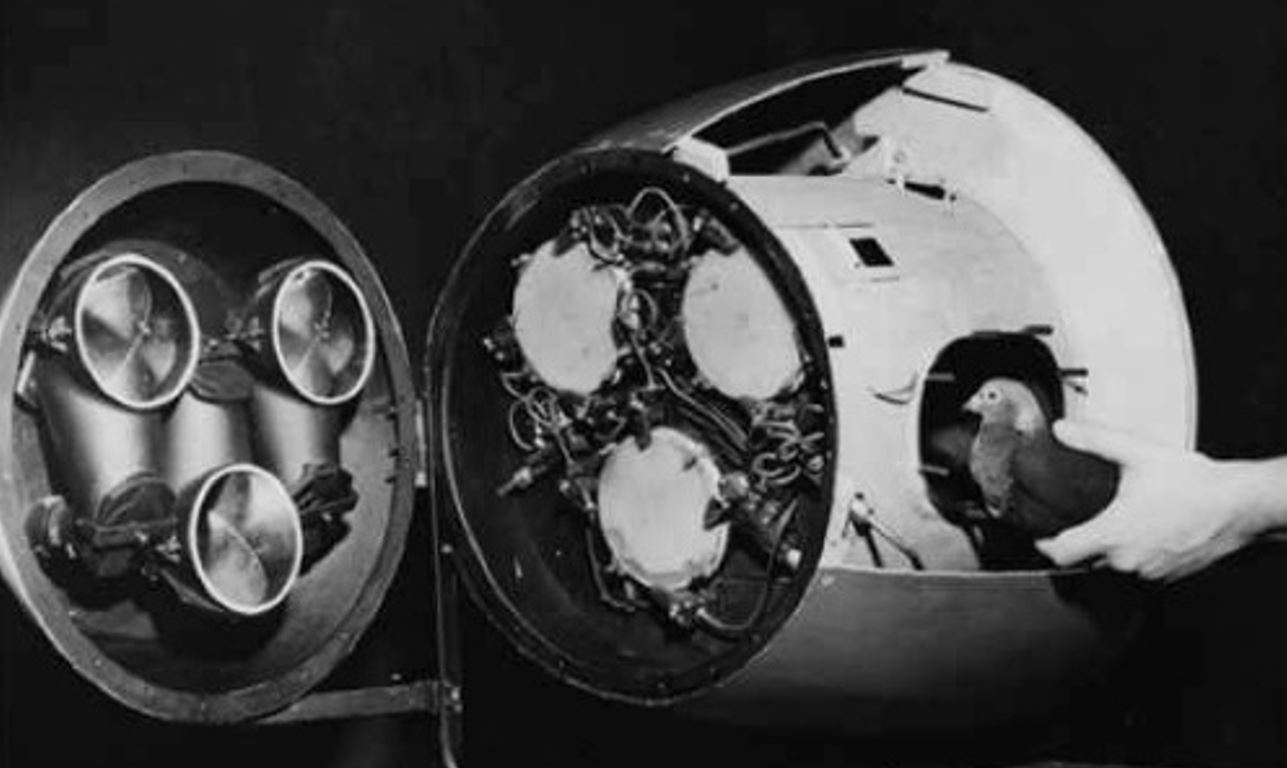
In contrast, the U.S. Army did not deploy them during World War II, although B. F. Skinner, a pioneer of behavioral research, had demonstrated that pigeons trained to recognize specific ground targets could be used to guide rockets and cruise missiles. Fortunately (for the pigeons), the generals’ skepticism prevailed, and the project was not pursued further, even though this method was far superior to the optoelectronics of the time.
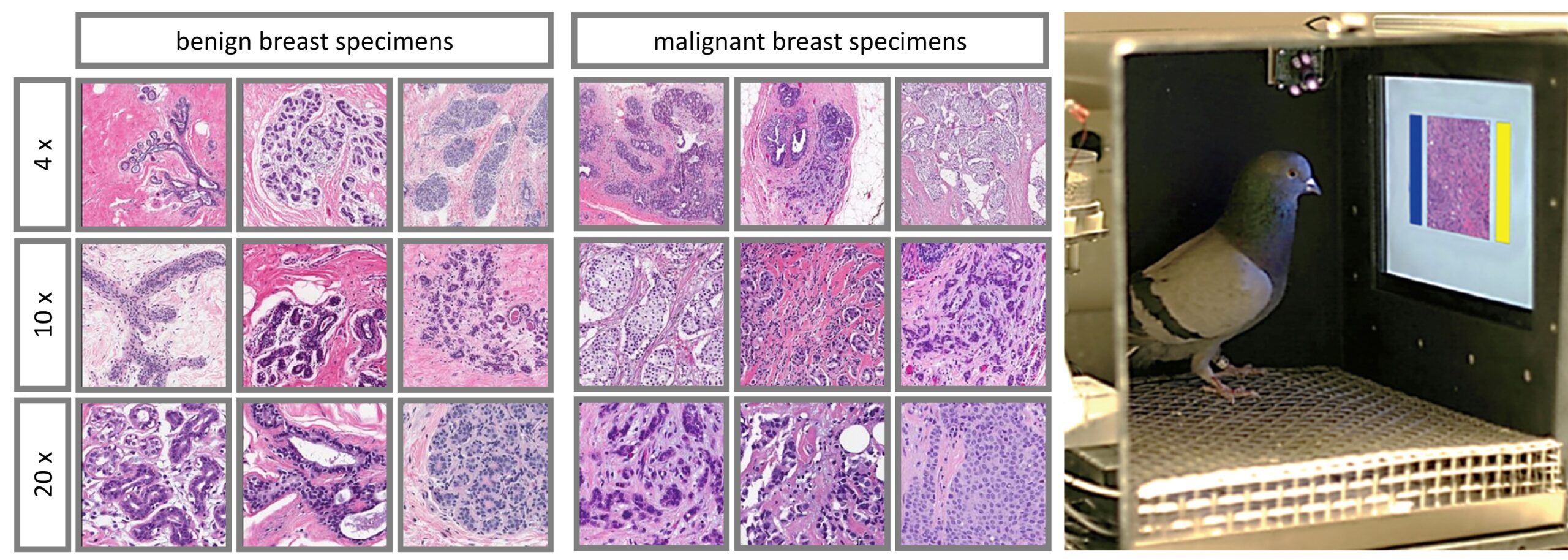
Some pigeons with a «medical degree» are doing an exceptionally good job in various American hospitals. They have been trained to recognize breast tumors in images of tissue samples and to reliably distinguish them from healthy tissue, achieving accuracy rates that even experienced histologists cannot match. They require only brief training, and once the characteristic features of a tumor have «become clear» to them, it is almost irrelevant in what magnification, color, or resolution the images are presented. They possess the «specialist’s eye» and are not distracted by anything.
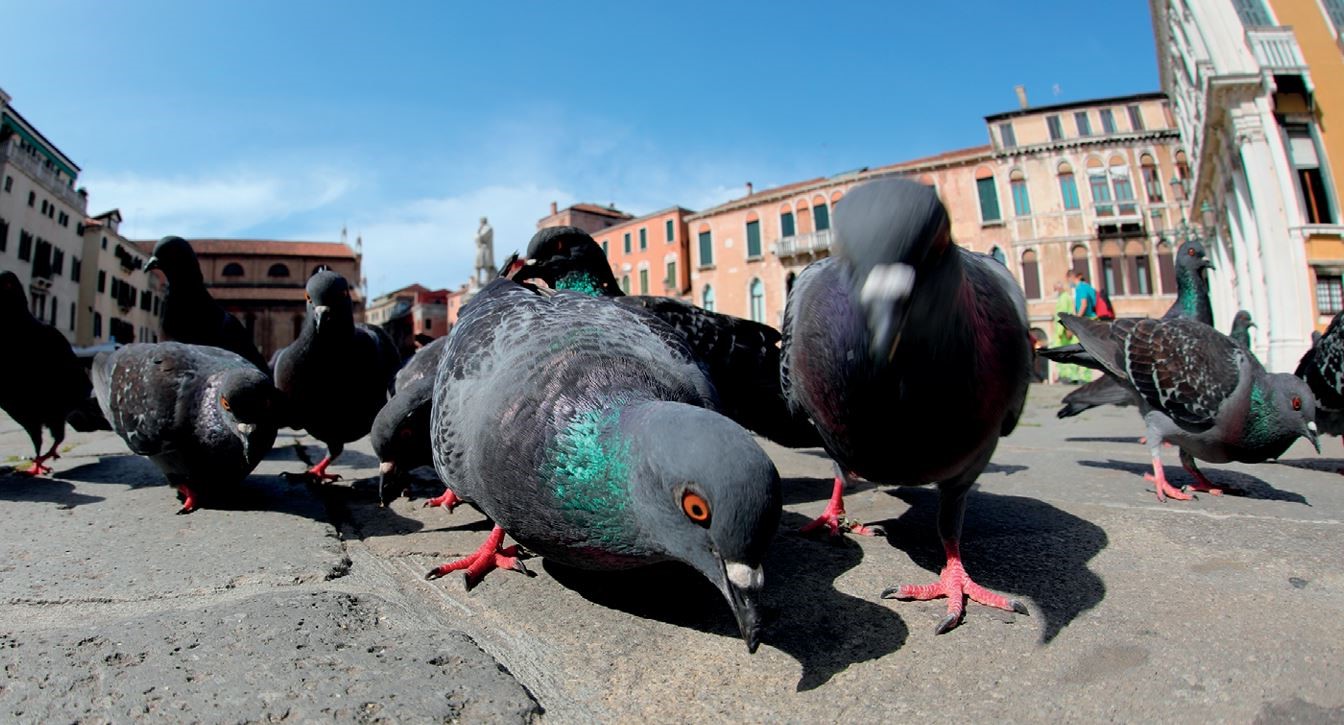
In large cities, the pigeon is often regarded as a dirty, quarrelsome, noisy, disease-transmitting pest that defaces monuments and should be reduced by poison bait, traps, and hunting. In its defense, however, it must be said that it becomes a «problem animal» only where it finds an overabundance of food—through openly discarded food waste and (well-intentioned) feeding—multiplies enormously, and forms huge flocks. In lifestyle and behavior, these feral domestic pigeons—known as city or street pigeons—differ greatly from their ancestors.
What did the Lord Jesus mean by the admonition: «Behold, I send you out as sheep in the midst of wolves; therefore be wise as serpents and harmless as doves» (Mt 10:16)? The «simplicity» required here (Greek akeraios), which can also be translated as «without deceit, innocent, sincere», etymologically means «unmixed, uncorrupted, pure» and refers both to our effect on others and to our perception.
The former means that there should be no discrepancy between appearance and reality. Our words and actions should align with what we are and what we believe—just as the Lord Jesus could answer the question «Who are You?» with: «I am what I have always claimed to be» (Joh 8:25). As for simple perception, we can learn from the dove’s outstanding ability to discern. Whoever lives «simple concerning evil» (Rom 16:19) «in a dark world full of corrupt and misguided people» (Phil 2:15) will not be distracted by their surroundings but will focus on the Lord Jesus: «The lamp of the body is your eye; if your eye is single [Greek haplous = unfolded, open], your whole body will also be full of light» (Mt 6:22; Lk 11:34).
Sources:
Aust, U; Huber, L: Elemental versus configural perception in a people-present /people-absent discrimination task by pigeons. Learning& Behavior 2003, 31 (3), 213-224; doi: 10.3758/BF03195984
Beason, R.C. & Wiltschko, W: Cues indicating location in pigeon navigation. Journal of Comperative Physiology A 2015; 201:961-967; doi:10.1007/s00359-015-1027-2
Berghaus, JI: Geschichte der Schifffahrtskunde bey den vornehmsten Völkern des Alterthums (pp. 528-530). Leipzig (Gräffiche Buchhandlung) 1792
Delius, J: Komplexe Wahrnehmungsleitungen bei Tauben. Spektrum der Wissenschaft 1986; 46-58; ISSN 0170-2971
Delius, J; von Fersen, L: Schlußfolgerndes Denken bei Tauben. In: Spektrum der Wissenschaft 1992; 7:18-22; ISSN 0170-2971
Fagot, J; Cook, RG: Evidence for large long-term memory capacities in baboons and pigeons and its implications for learning and the evolution of cognition. PNAS 2006; 103(46):17564-17567; doi: 10.1073/pnas.0605184103
Heldmaier, G; Neuweiler, G: Vergleichende Tierphysiologie. Heidelberg (Springer) 2003; doi: 10.1007/978-3-642-55699-9
Herrnstein, RJ; Loveland, DH: Complex Visual Concept in the Pigeon. Science 1964; 146(3643):549-551; doi:10.1126/science.146.3643.549; http://www.pigeon.psy.tufts.edu/avc/huber/
Kowalski, U: Das Richtungsverhalten verfrachteter Brieftauben (Columba livia) im Orientierungskäfig. Journal of Ornithology (1994); 135:17; doi: 10.1007/BF01640273
Kreithen, ML; Eisner, T: Ultraviolet light detection by the homing pigeon. Nature 1978; 272:347-348
Kreithen, ML; Quine, DB: Infrasound Detection by the Homing Pigeon: A Behavioral Audiogram. Journal of Comperative Physiology 1979; 129:1-4
Levenson RM, Krupinski EA, Navarro VM: Pigeons (Columba livia) as Trainable Observers of Pathology and Radiology Breast Cancer Images. PLoS ONE 2015 10(11): e0141357; doi: 10.1371/journal.pone.0141357
Maier, EJ: Das UV-Sehen der Vögel: Neue Ergebnisse über den spektralen Sehbereich der Vögel. Journal of Ornithology 1994; 135:179; doi:10.1007/BF01640287
Award of the Dickin Medal to «Winkie»: http://www.vconline.org.uk/winkie-dm/4594632037
Quine, DB; Kreithen, ML: Frequency shift discrimination: Can homing pigeons locate infrasounds by Doppler shifts? Journal of Comperative Physiology 1981; 141:153; doi:10.1007/BF01342661
Quine, DB: Infrasounds: A Potential Navigational Cue for Homing Pigeons (in: Avian Navigation – Proceedings in Life Sciences S. 373-376). Heidelberg (Springer) 1982; doi: 10.1007/978-3-642-68616-0_39
Schermuly, L; Klinke, R: Infrasound sensitive neurones in the pigeon cochlear ganglion. Journal of Comperative Physiology A 1990; 166:355-363
Watanabe, S: Discrimination of painting style and quality: pigeons use different strategies for different tasks. Animal Cognition 2011; 14:797: doi:10.1007/s10071-011-0412-7
Image Credits:
Wikipedia: Rock dove in flight / Alan D. Wilson // Pigeon with camera / Hans Adler
other licenses: Title – Pigeon in flight / shutterstock_1605518809.jpg / N.Z. Photography // Wedding doves / AdobeStock_85724315.jpeg / Volodymyr // Pigeon feeding its young / shutterstock_2064399635.jpg / christianthiel.net // Sculpture of the peace dove / shutterstock_620481428.jpg / PIC2FRAMES // City pigeons / shutterstock_1857362218.jpg / ChiccoDodiFC // Graphic of Winkie rescue operation / Taube_winkie.jpg / Romely vom Stein // Pigeon at work / myerspel4e_06un06.jpg / Levenson