To gain a better impression of the geographical and biological conditions of our beautiful planet, let us regard it in this fictional scenario as a model on a scale of «one to one million». We are writing the year 2045 …
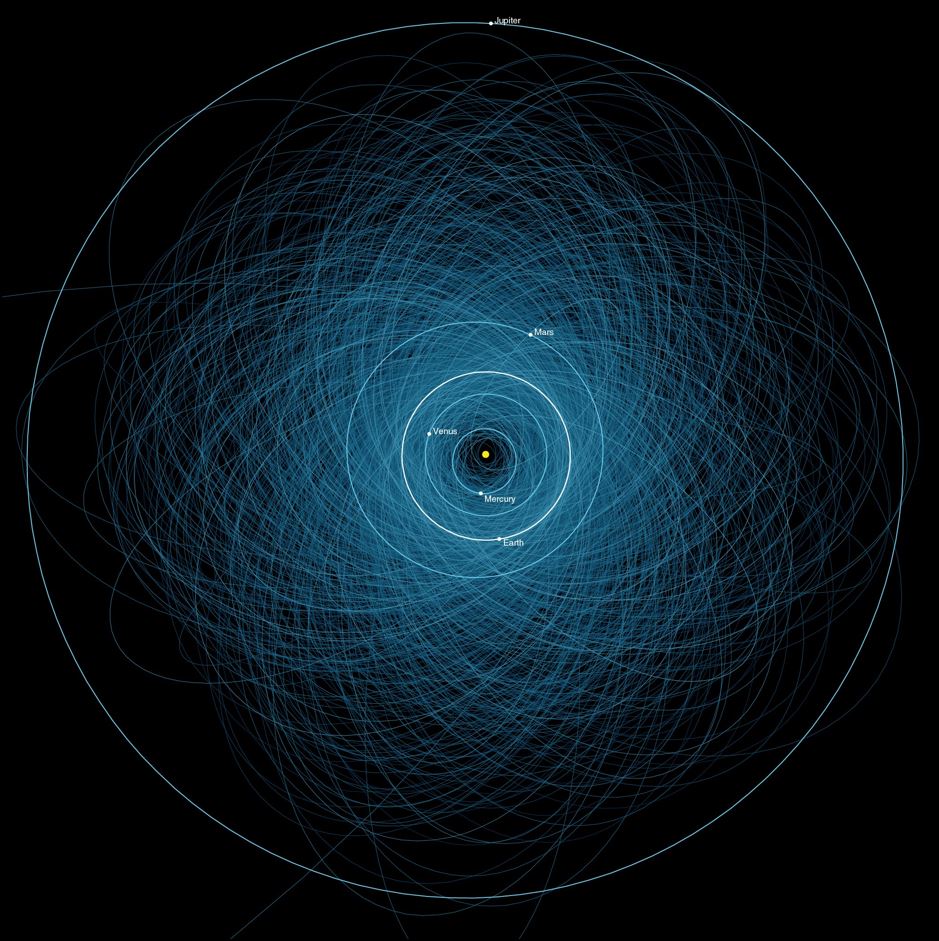
When data from the Lincoln Near Earth Asteroid Research (LINEAR) program first indicated that comet 109P/Swift–Tuttle was on a collision course with Earth and would impact on August 14, 2116, Operation SPACE-ARK was initiated. Since then, feverish work has been underway on plans for the complete evacuation of Earth’s landmasses (aquatic organisms are better protected in their element, and their populations will probably recover from the impact). According to the UN bioethics resolution, every living being is equally worthy of protection; therefore, no terrestrial creature may be left behind. Now, for the first time, detailed plans are available – for a relocation to our neighboring planet Mars!
Mars is suitable for many reasons. First of all, it is relatively easy to reach. Temperature and gravity are within tolerable limits, and there is even a thin atmosphere. Moreover, its surface area corresponds almost exactly to the land area of Earth, which greatly facilitates a 1:1 transfer. In addition, there are 24-hour days and, due to its axial tilt, even four seasons (although the Martian year has 669 days).
Fortunately, thanks to the newly developed flux compensator technology, virtually unlimited energy is available everywhere. This makes it possible to realize geoengineering projects on an unprecedented scale. Thus, the planet’s geological structures – for example, the seven-kilometer-deep Mariner valleys or the 26-kilometer-high volcano Olympus Mons – will be completely leveled, and all raw materials required for settlement will be extracted by open-pit mining. These preparatory measures will take up the largest portion of the available time.
The blueprint for the colony elements on Mars was «Biosphere II», a complex built in Arizona in 1991 in which the conditions of an independent, closed ecological system were explored for the first time (see title image).
At the time, the project was considered a failure, but much has been learned since then. The new settlement scheme «Biosphere III» envisages covering Mars entirely with similarly designed ark modules. In honor of the billionaire Perry Edward Bass, who had financed the predecessor model, they are referred to as «Bass Boxes». A Bass Box is a square structure with an edge length of 12 kilometers, hermetically sealed against the outside world and containing a miniature version of Earth’s land surface. Exactly one million of these boxes can be accommodated on Mars. It is worth studying the Bass Box more closely to gain a sense of global proportions. An area of 12 × 12 kilometers is something most people can imagine quite well in their own neighborhood, and experienced hikers can just manage to walk around it in a single day. Today, only those involved in agriculture, forestry, or landscape planning are familiar with the unit «hectare» (ha). A soccer field (typically 68 × 105 meters), by contrast, is a very illustrative size even for non-athletes. Therefore, from now on calculations will be made in soccer fields (SF).
For a rough overview of Earth’s surface, the rule of thirds is helpful: 1/3 of Earth’s surface is land, 1/3 of that is usable land, and 1/3 of this is arable land. The total of 20,000 SF in a Bass Box represent only Earth’s land area and include 2,400 SF available for agriculture. That is quite a lot, but considering that 8,000 people live in each colony, one can calculate that one soccer field of farmland must feed three people. As long as farming is done sensibly and there are no crop failures, that is more than sufficient. However, not all of the area is used for food production. For example, 100 SF are used to produce fibers (cotton, flax, jute, and sisal). Rapeseed grows on 47 SF and sugarcane on 37 SF – both mainly for energy production. Even the yield from the 250 SF of maize is mostly not eaten, but converted into bioethanol and biogas to be burned. (Thanks to the flux compensator, this will hopefully change now.)
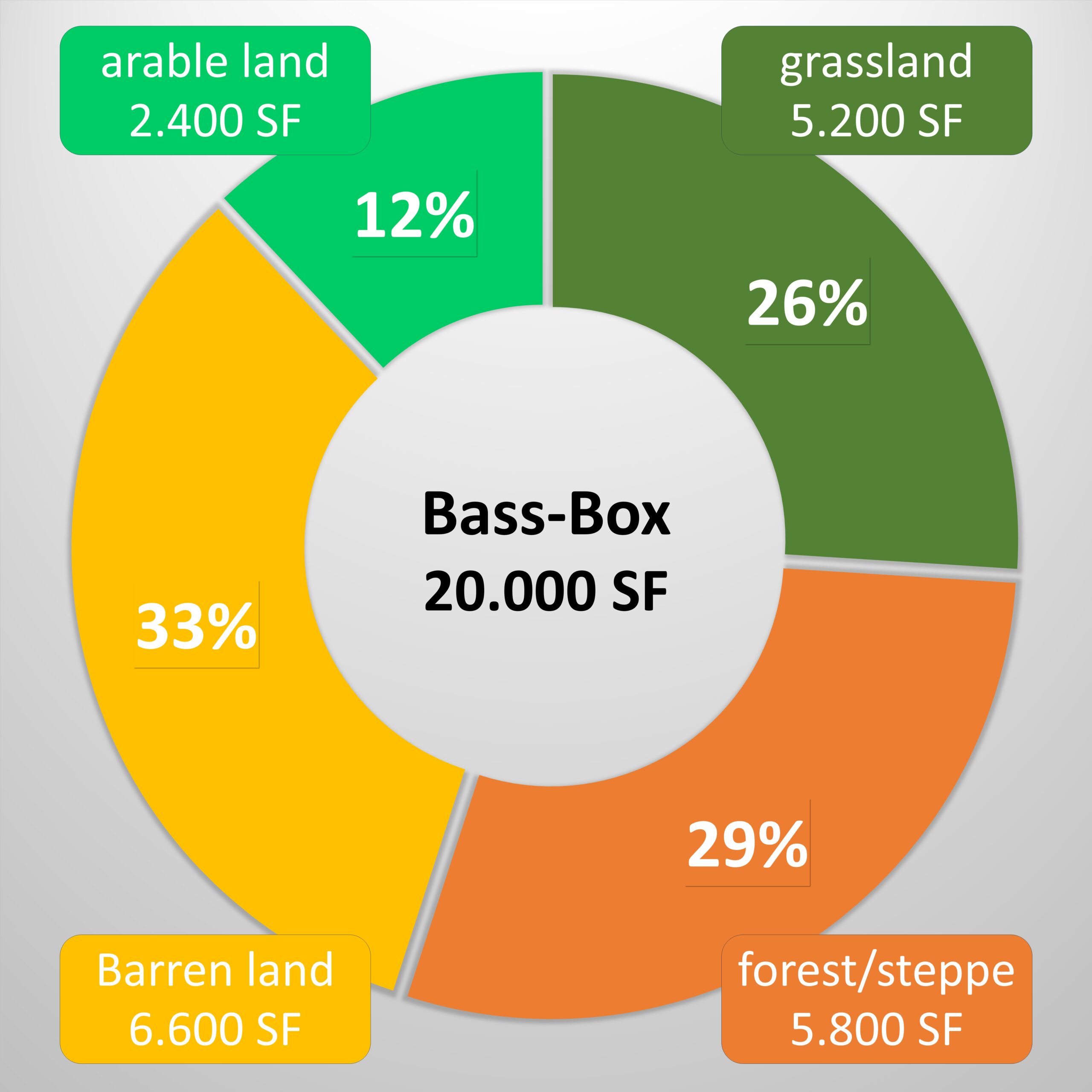
Anyone who grew up in a large city (as most people do today) gains the impression that Earth’s surface is predominantly sealed with asphalt and concrete. In the Bass Box, one can see that it is not quite so bad. Residential areas and infrastructure for the inhabitants occupy an area of 308 SF – about 1.5% of the total area.
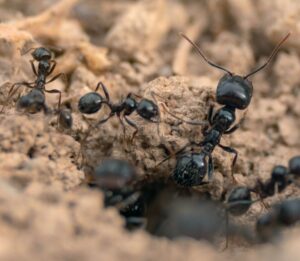
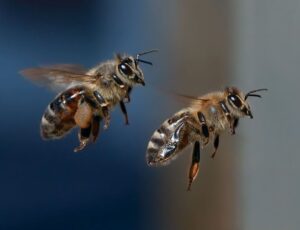
The focus of this book is on land-dwelling mammals. Their populations in the Bass Box are of an illustrative size. It may surprise the reader that, at the level of biological species, there are no more than 8,000 individuals of any mammal species. There are no more brown rats, black rats, or house mice than there are humans. It is assumed that sometime between 2021 and 2024 the point was reached at which there were more individuals of Homo sapiens than of any other mammal species.
Ein weiterer erstaunlicher Fakt ist, dass die Herden der ältesten und wichtigsten Haustiere ähnlich groß sind. Es gibt in einer Bass-Box, mit geringen Schwankungen, 1.000 Schafe, 1.000 Ziegen und 1.000 Rinder. Die 760 Schweine fallen dagegen ein wenig zurück. Hält man sich die Vermehrungsraten der Tiere und die 8.000 menschlichen Konsumenten vor Augen, wird klar, dass der Fleischkonsum kein ökonomisches Problem sein muss. Es ist genug für alle da. Es gibt noch ein paar weitere Pflanzenfresser: 60 Esel und Maultiere, 60 Pferde und 20 Kamele. Am Ende grasen auf den 5.200 FF Grünland etwa 4.000 Weidetiere. Damit ist reichlich Platz vorhanden.
The number of wild animals, by contrast, hardly matters, which is also surprising. Of no wild herbivore species are there enough animals for each of the one million Bass Boxes to maintain its own herd. They will have to be distributed – here there are wildebeest, there buffalo, there zebras, there impalas (and preferably also the cheetahs there, because for predators it is even more true that all species have comparatively small populations).
Of the 500 dogs that must be accommodated in each colony, currently only a quarter are house-trained and vaccinated. The other flea-infested strays would still have to be somewhat «socialized» for life on Mars. No one needs to worry about the thousands of rats and mice; they have always managed well on their own and will populate every corner on Mars as well (unless a special clause defining «vermin» is added to the UN bioethics resolution beforehand).
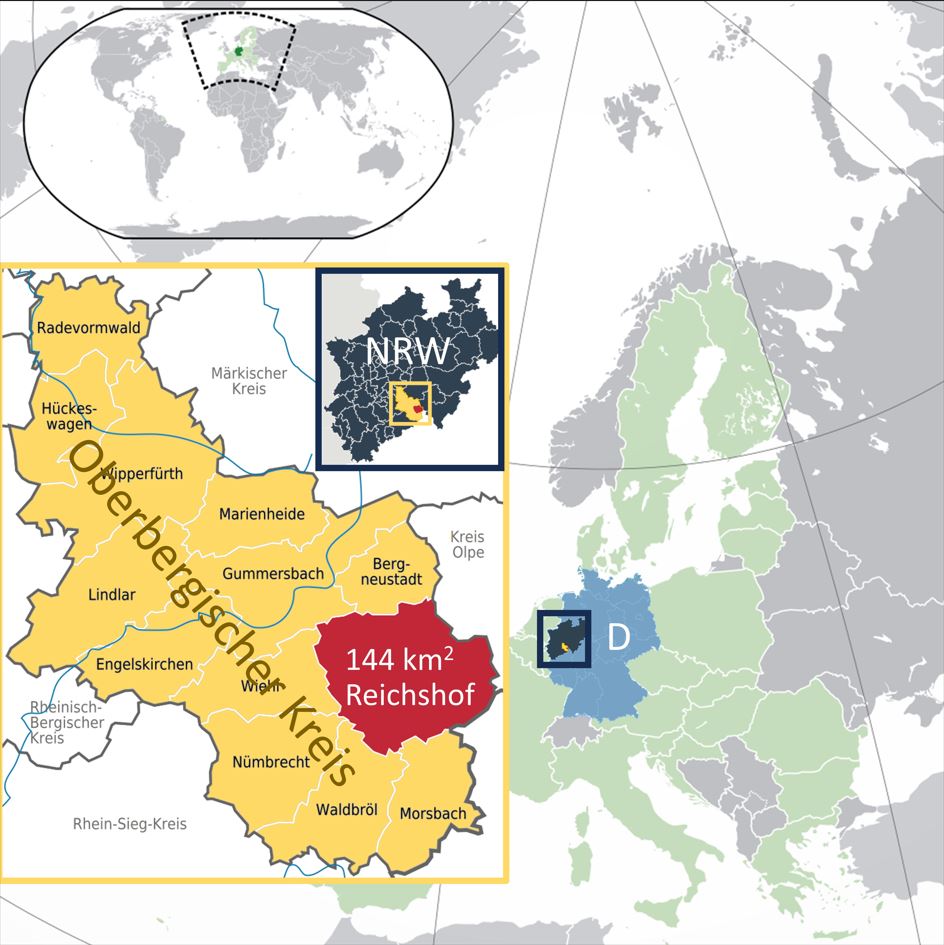
How the population will be divided is still under discussion … Will there be 10,000 German Bass Boxes, or would 80 Germans per Bass Box be better? And in that case, would it be worthwhile to teach the eleven schoolchildren in a mixed-age class (after all, there are two German-speaking teachers there) …
– FICTION OFF –
Perhaps some readers share a fascination with imaginative visions of the future and could lose themselves in them just as much. For many people, however, such scenarios are more than fantasies. «Futurology» sees itself as a serious discipline concerned with the «systematic and critical scientific investigation of questions of possible future developments in the technical, economic, and social fields». The permanent settlement of the planet Mars and the possibility of a catastrophic comet impact on Earth have been discussed there for decades.
From a scientific perspective, it is obvious that statements about future developments are fraught with great uncertainties, and there is no generally accepted method even for calculating probabilities of certain events and developments. The situation looks quite different, however, when one considers the question biblically. God not only knows the future in detail, He is the One who ultimately directs it. Everything follows His plan, the «counsel» of God (Ps 33:11; Isa 46:10; Acts 4:28). In comparison with this biblical and real perspective of the future, even the boldest human visions pale. It is worth studying this outlook (e.g., with the help of the book «A Thousand Years of Peace – Biblical Prophecy Today»).
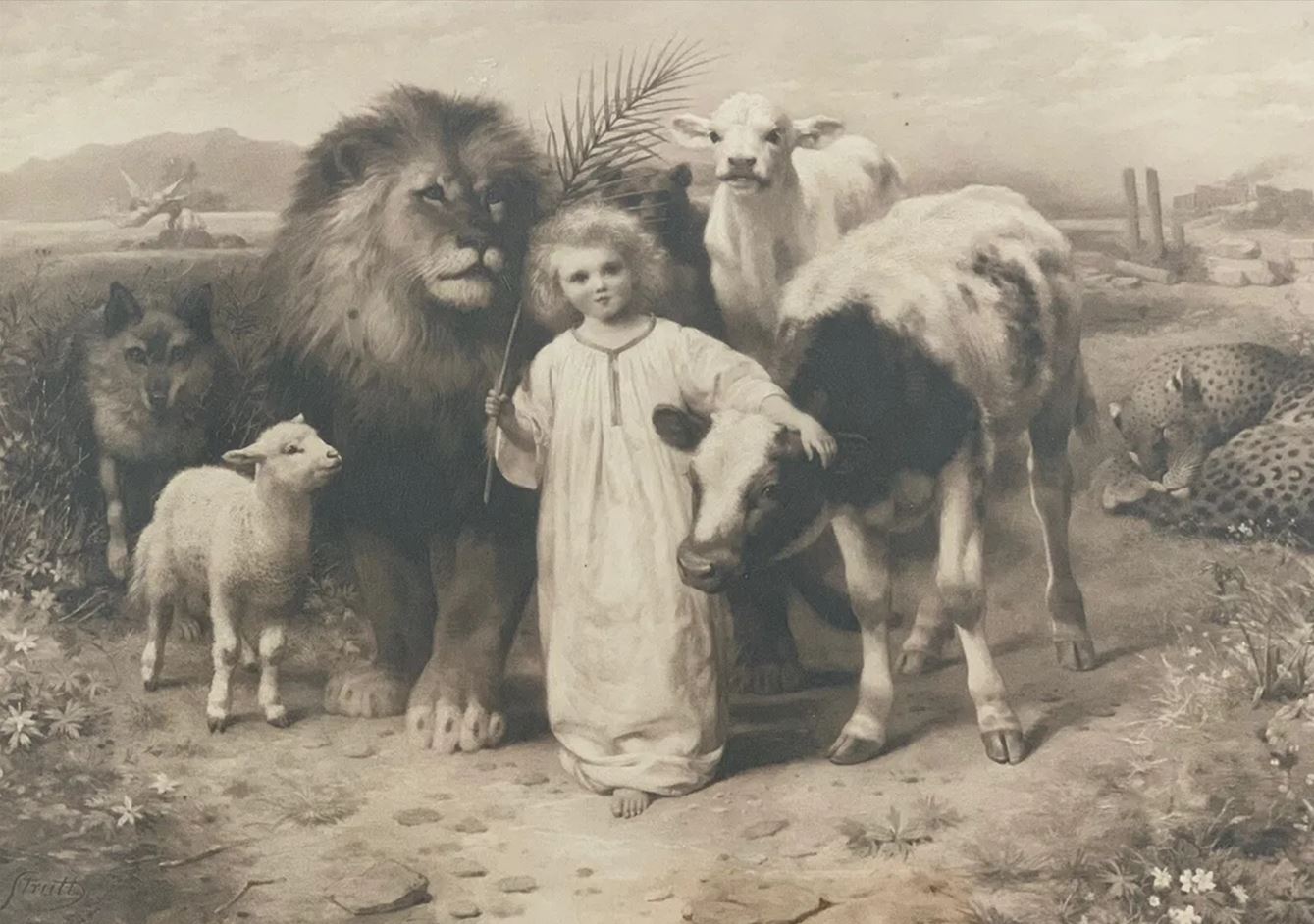
One aspect of these future conditions on Earth must absolutely be addressed here in the book – the «peace among animals». Hunters and carnivores will once again feed vegetarian diets and live peacefully together with their current prey. From a biological point of view, there is no model for how an alternative regulation of population densities could look and how food webs could function in this setting. But the fact that we cannot model a scenario with our current state of knowledge does not mean that it cannot nevertheless be possible. The coexistence of humans and animals, which today is often characterized (in both directions) by «fear and dread» (Gen 9:2), will also be transformed again into a harmonious togetherness.
Despite this far-reaching restoration, the Earth will remain a testing ground for humanity during this time of peace. Only after the final showdown (Rev 20:7–10) will no further testing be necessary. The entire cosmos will then pass away and be replaced by «a new heaven and a new earth» (Rev 21:1; cf. Isa 65:17; 2Pet 3:13). If our present world is «Biosphere I» and the coming kingdom of peace is «Biosphere II», then here we have before us the actual and final «Biosphere III». Will there be an animal and plant world there again? – One may be curious, but given how we have come to know God as Creator, we find that boundless diversity, lavish abundance, breathtaking beauty, unsurpassable harmony, grand dynamics, ingenious functionality, surprising complementarity, and conceptual brilliance simply belong to His «corporate identity». What comes from His creative workshop cannot be otherwise! And then the old philosophical question of whether evil must exist so that good can be good will answer itself.
Sources:
Cohen, JE; Tilman, D: Biosphere 2 and Biodiversity – The Lessons So Far. Science 1996; 274(5290):1150-1151; doi: 10.1126/science.274.5290.1150
Mücher, W: Tausend Jahre Frieden. Retzow (Daniel) 2004
Nelson, M; Allen, JP; Dempster, WF: Biosphere 2: A prototype project for a permanent and evolving life system for Mars base. Advances in Space Research 1992; 12(5):211-217; doi: 10.1016/0273-1177(92)90026-T
Nelson, M: Some Ecological and Human Lessons of Biosphere 2. European Journal of Ecology 2018; 4(1):50-55. doi: 10.2478/eje-2018-0006
Image Credits:
Wikipedia: Titel – Biosphere II / CGP Grey // Comet orbits / NASA/JPL-Caltech