
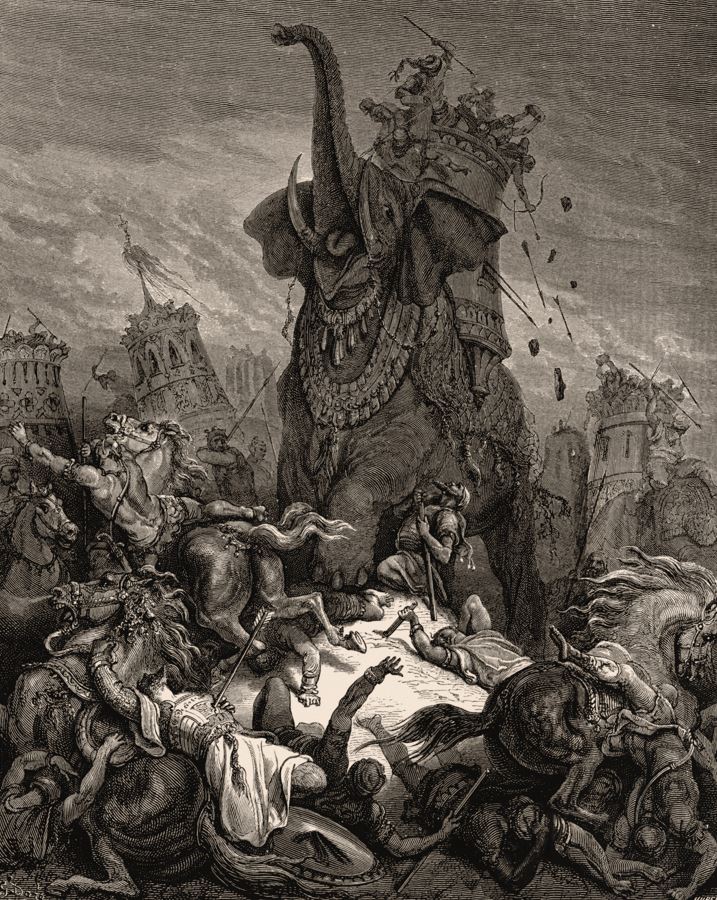
Although these pachyderms are not mentioned directly in the Bible, during the time of the Maccabean revolts they were equipped with wooden superstructures and sent into battle as the «tanks of antiquity». Many inhabitants of the Roman Empire were familiar with them in the time of the New Testament as circus animals. Their distinctive tusks have always been a coveted luxury commodity.

The Hebrew word pil, which designates the elephant, does not occur in the Bible, nor does the Greek word elephantas. But in elephantinos (Rev 18:12), the Greek term for ivory, one can at least hear it echoed. With the Hebrew shenhabbim (1Kgs 10:22; 2Chr 9:21), one can only conjecture that it is meant to signify «tooth of elephants», without the latter part of the word having been linguistically assigned with certainty to date.

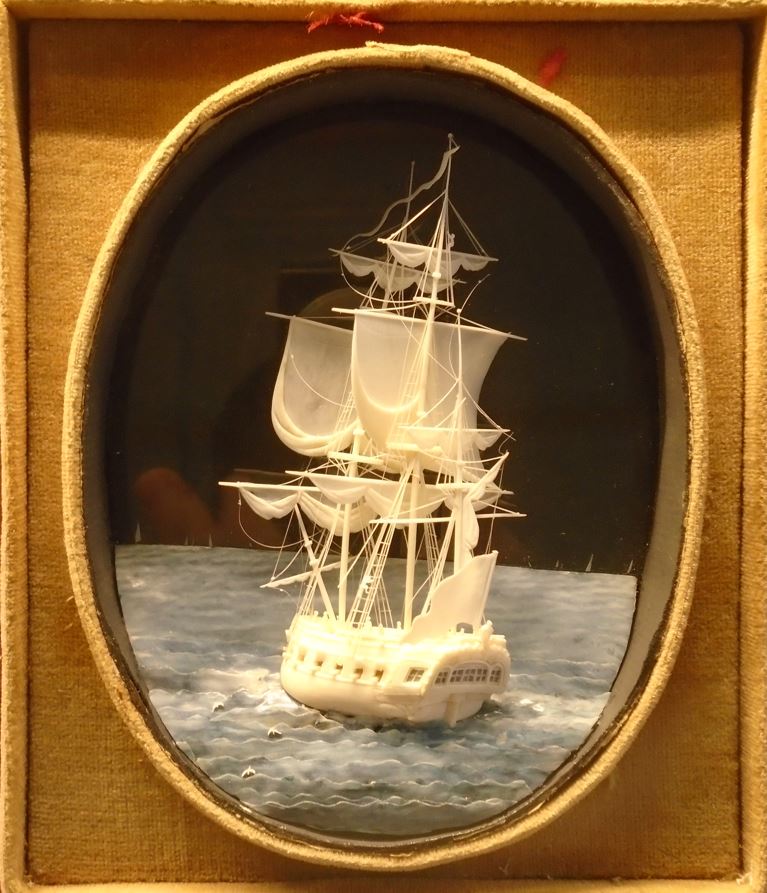
Otherwise, ivory is simply called shen (7x), which quite generally denotes teeth (39x). Of interest is the expression karnot-shen (Ezek 27:15), which means something like «horn-teeth» or «ivory horns» and perhaps refers to the natural tusks (in contrast to the processed material). The German word «Elfenbein» has a similar meaning and is composed of Elefan(t) and Bein (= bone).

Because both the African elephant (Loxodonta africana) and the Asian elephant (Elephas maximus) were hunted in regions that maintained trade relations with the Near East, the ivory may derive from either species. In addition, even in antiquity the teeth of the extinct mammoth (Mammuthus primigenius) were traded; they are still frequently found in the far north today and, in most countries, constitute the only legal source of this precious material. The massive canine tusks of hippopotamuses are also made of the same dentine and were likewise worked into carvings.
Elephants are without doubt the largest and strongest land animals alive today. The record museum specimen of the African elephant has a shoulder height of four meters and a weight of around ten tons. The head-and-body length amounts to an incredible eight meters – benefiting from the definition «tip of the nose to base of the tail», since it must be measured all the way down to the tip of the trunk. The tail then measures another 150 centimeters.
Against this background, one can sense the symbolic significance of ivory. The expression «horn-teeth» in Ezekiel 27:15 describes the tusks of elephants and mammoths as a combination of teeth (which represent the power of predatory animals) and horns (which represent the power of hoofed animals). Because of their enormous dimensions – the largest known mammoth tusks are almost five meters (!), those of the elephant still nearly three and a half meters long – and because they belong to the strongest land animals known at the time, ivory is regarded as a symbol of supreme power. At the same time, the color «white» in the Bible stands for purity and righteousness.
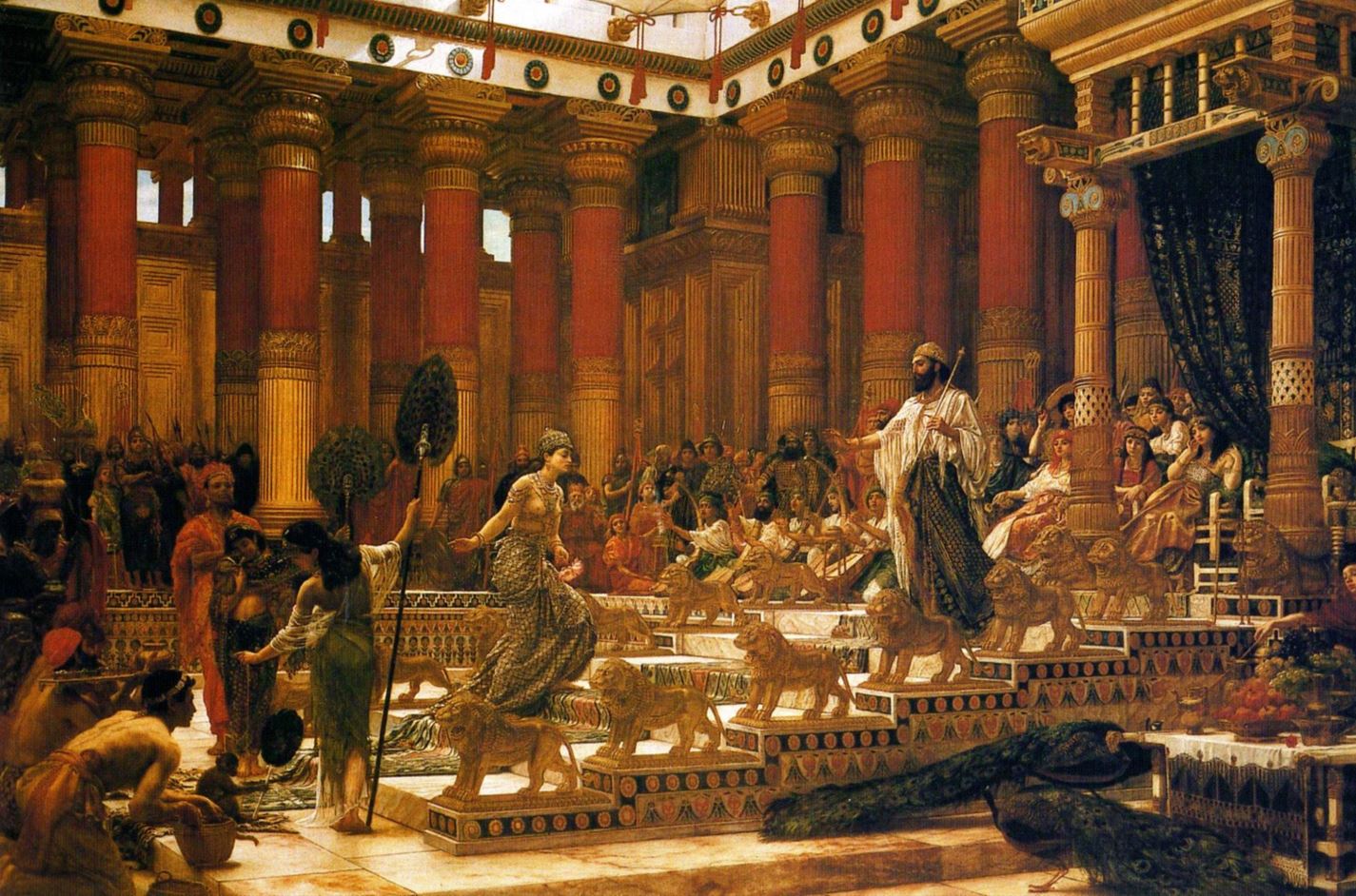
The imposing lion throne of King Solomon was made of ivory overlaid with refined gold (1Kgs 10:18; 2Chr 9:17). In the context of biblical prophecy, this is an image of the highest throne from which the Lord Jesus reigns (Matt 25:31). All the attributes – the seven lions on the right and left, the ivory, and the gold – symbolize the character of His rule: power, righteousness, permanence, and glory. At the final judgment, the Lord will sit upon a great white throne, as it were of pure ivory, and with absolute authority and justice pronounce judgment upon every unredeemed person (Rev 20:11–15). It is good to remember: «Everyone must die once, and after that comes judgment» (Heb 9:27) – and to know and proclaim to others the way out: «Therefore, there is now no condemnation for those who are in Christ Jesus» (Rom 8:1).
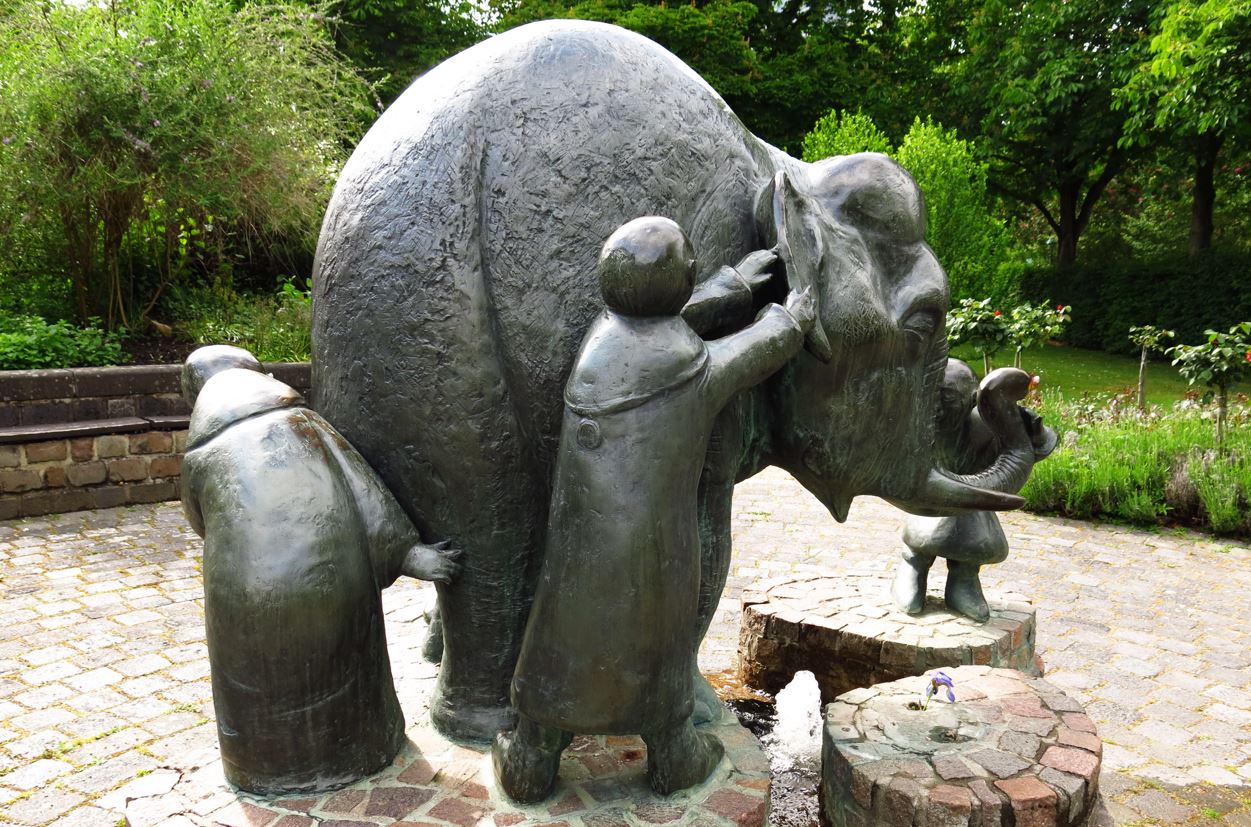
When elephant and Bible are mentioned together today, in most cases it is not about war elephants in combat with the Maccabees, but about the «parable of the elephant». It is already found in many ancient writings, and there are numerous versions which all share, as a common core, the following plot: «Several blind men attempt by touch to discern the nature of an elephant. Each touches a different part of the animal, resulting in very different descriptions. One who has felt the trunk arrives at the judgment “snake-like”, another considers the leg to be “pillar-shaped”, one who has only felt the tusk speaks of “spear-like”, the one who groped along the side of the body of a “great wall”, and a final one, who held only the bristly tail in his hand, calls it “broom-like”.»
At first, this story merely illustrates in a pleasant way the truism that complex and multifaceted matters can be viewed from different perspectives (and often not perceived «as a whole» at all). However, it is readily employed in religious education to illustrate that every seeker, every «believer», and every religion has different perceptions, insights, and approaches to God, without these necessarily contradicting one another. From this it is then often inferred that in matters of faith there can be no «absolute (or objective) truth».
At first glance, this may sound plausible. On closer inspection, however, one notices that something does not quite fit. The parable is told from the perspective of a «seeing» person who recognizes the elephant as a whole (otherwise it would make no sense). Whoever uses this story to equate people who believe in «absolute truth» with the blind thereby claims for himself to be a «seer». He believes he knows exactly what the question of God is about. If he communicates this as a generally binding insight, he entangles himself in an obvious self-contradiction: what is allegedly impossible has now succeeded for him – he recognizes an objective truth that applies not only to himself but equally to all people.
In one point the parable is very apt: no human being is able, of himself, to recognize God. Precisely for this reason, however, the transfer to Christians fails. In contrast to Judaism, Islam, and other religions, Christianity proclaims the perfect self-revelation of God through the Lord Jesus. God, whom no one has ever seen (Joh 1:18), became human in Jesus. He could not only, but also (Lk 24:39; 1John 1:1), be touched; He was seen, heard, and experienced. Apart from Him there is «nothing to see» of God (Joh 14:9; Col 2:9). It is as if, in the parable, the elephant began to speak and explain himself to the blind in the fullest detail.
In the song «Einer durchbrach den Himmel», postmodern truth relativism is aptly satirized. The refrain says: One broke through heaven (3x) – Jesus is the way to God!
Einer durchbrach den Himmel
Werner Hoffmann & Gregor Breier, 1992
(translated, original in German)
They say: You can go by many paths,
and much will bring you close to God.
For whoever does good
is, in the end, good.
Nothing is absolute,
everyone arrives someday.
They say: There is no single truth,
and seeking is not bad in principle.
Every religion
already has the truth,
has a piece of it.
All are right.
And Jesus says: Whoever trusts me lives.
Only the one who knows Jesus comes to the Father.
His power alone
can free from guilt,
tears down the wall
that separates us from God.
Sources:
Chaiklin, M: Ivory in World History – Early Modern Trade in Context. History Compass 2010; 8:530-542; doi: 10.1111/j.1478-0542.2010.00680.x
Hanks, J: Growth of the African elephant (Loxodonta africana). African Journal of Ecology 1972; 10:251-272; doi: 10.1111/j.1365-2028.1972.tb00870.x
Heckel, C: Physical characteristics of mammoth ivory and their implications for ivory work in the Upper Paleolithic. Mitteilungen der Gesellschaft für Urgeschichte 2009; 18(7):71-91; https://www.academia.edu/download/1851478/071-092.pdf
Hoffmann, WA; Breier, G: Himmelsdurchbrecher (song, quotation translated from German). Accessed 23 Dec 2023: https://www.evangeliums.net/lieder/lied_einer_durchbrach_den_himmel.html
Kazantzakis, N: Die Blinden (German textbook, p. 128). Berlin (Cornelsen) 2017
Kubsch, R: Gibt es überhaupt Wahrheit? (#Go(o)d News 3, pp. 13-15). Dillenburg (Christliche Verlagsgesellschaft) 2022
Image Credits:
Wikipedia: War elephant in combat / Gustave Doré // Indian elephant / Yathin S. Krishnappa // Miniature ivory ship / Vyacheslav Kirillin (1994–) // Ivory concentric sphere / HellasX // Painting of Solomon’s throne / Edward Poynter // Blind Men’s Fountain in Bonn / Axel Kirch // Elephant family / Ikiwaner
other licenses: Title – African elephant / shutterstock ID_1995663878 / AndreAnita