As livestock, sheep and goats – jointly referred to as «small livestock» – have accompanied humanity since the very beginning of human history (Gen 4:2). Their wild relatives share the same habitat with them yet have very different ways of life.
Within the tribe of the goat-antelopes (Caprini), all species of sheep, goats, and ibex are grouped together. Because they share many characteristics, it is left to specialists to determine their precise relationships. A genetic indication of their close kinship is the fact that «geeps» are occasionally born – hybrids of sheep and goat.
While goats have 60 and sheep 54 different chromosomes, the geep, as a fair compromise, is born with 57 chromosomes. In the laboratory, embryos of sheep and goat were experimentally fused with one another at an early stage. The result was a hybrid creature that consisted half of «goat cells» and half of «sheep cells», yet developed entirely normally.
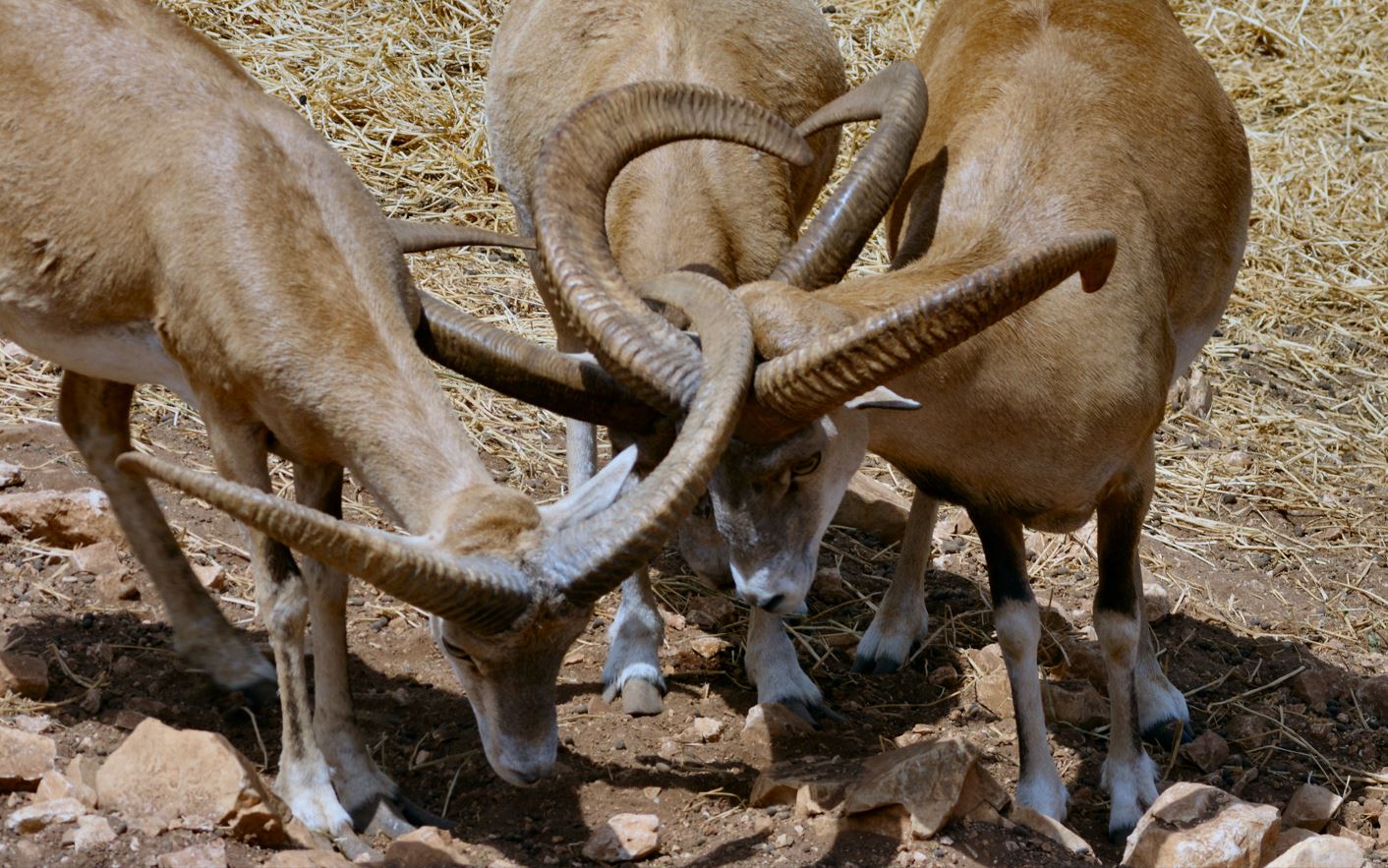
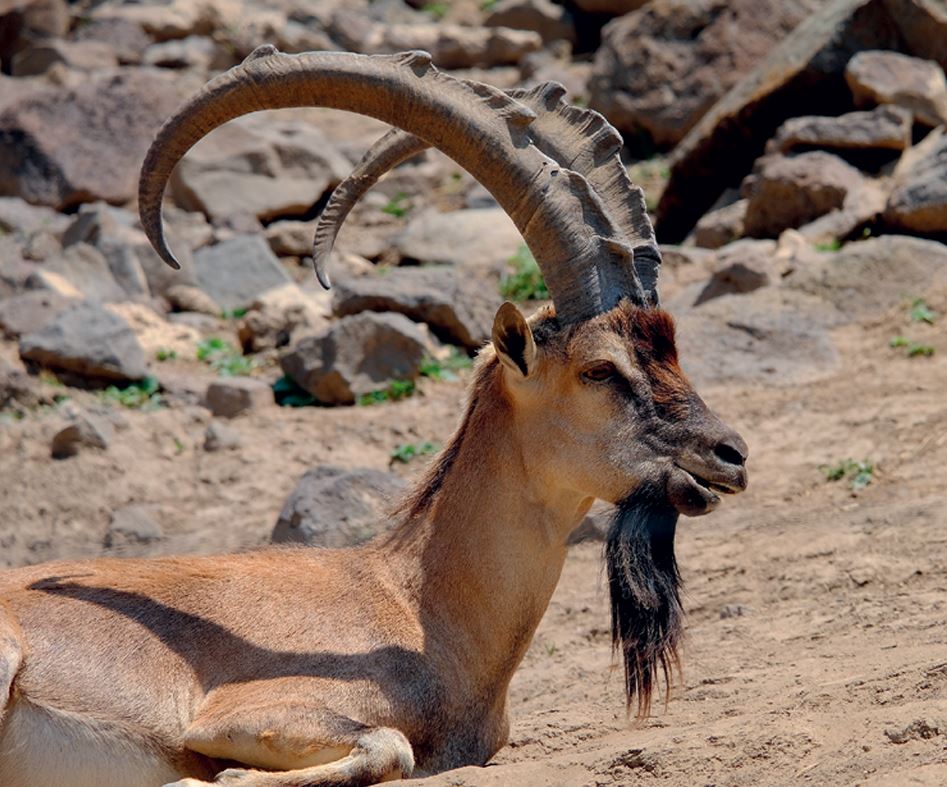
To this day, the Nubian or Syrian ibex (Capra nubiana) still exists in Israel. It is likely that the Hebrew designations akko (Deut 14:5) and ja’ala (Prov 5:19) refer to it, with the feminine form ja’el (Job 39:1; Ps 104:18) then denoting the female ibex. In the forms Jaala (Ez 2:56; Neh 7:58) and Jael (Judg 4–5), both appear as personal names, and with zur-hajaelim, the «Rock of the Ibex» (1Sam 24:3), also as a place name. Analogously, the nearby En-Gedi (Jos 15:62; 1Sam 24:1–2; 2Chr 20:2; Song 1:14; Ezek 47:10) is also interpreted as «Spring of the Ibex».
The Bezoar goat (Capra aegagrus aegagrus) was formerly native to Israel, but was displaced at a very early time by herds under human care. It is regarded as the ancestral form of the domestic goat. The Hebrew designation te’o (Deut 14:5; Isa 51:20) can probably be assigned to it.
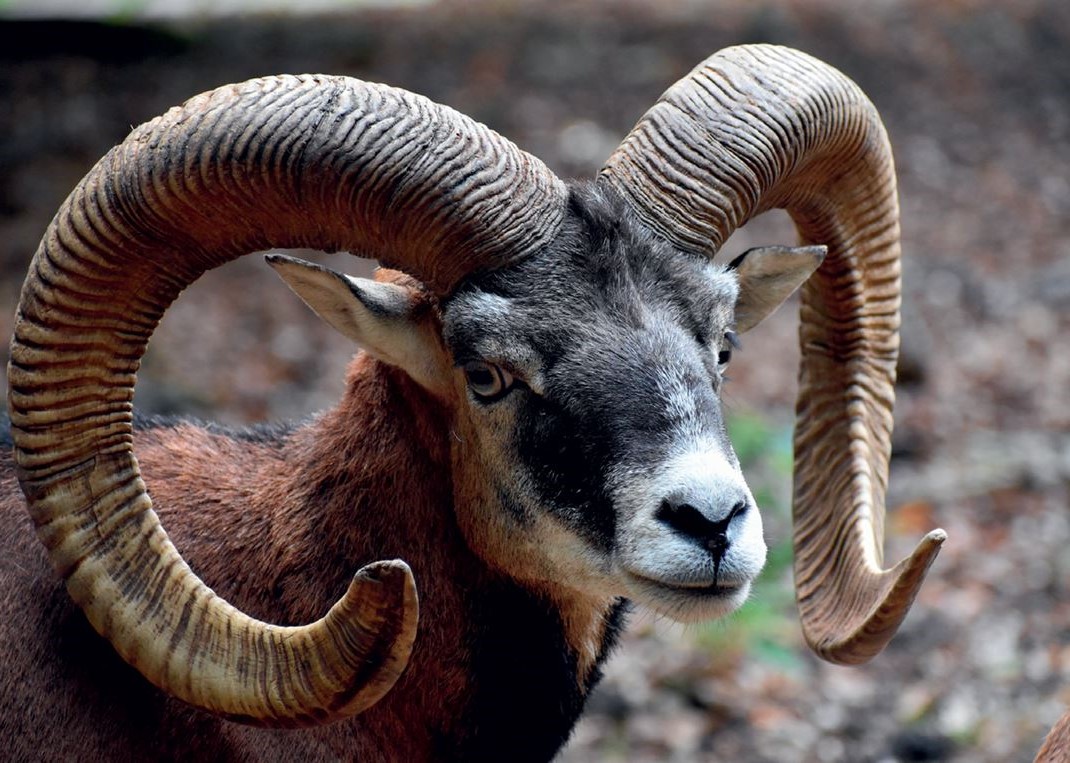
Also extinct in Israel is the Armenian wild sheep or mouflon (Ovis orientalis gmelini). From genetic data alone, it cannot be determined whether it represents a precursor of the domestic sheep or a feral form. Against the cultural-historical background of the Bible, the latter is more likely, since the domesticated form is mentioned very early. Like the wild goat, it had to give way to herds of tame sheep and is mentioned only in a single passage, under the Hebrew designation zemer (Deut 14:5). The context, however, suggests that the ram caught in the thicket, which Abraham was permitted to sacrifice in place of his son Isaac (Gen 22:13), was also a wild sheep. All three species were counted in Israel as huntable game (Deut 14:5), the consumption of which was permitted, since they are cloven-hoofed and ruminants, that is, pure animals.
The question « Do you know when the mountain goats give birth? … Do you count the months till they bear? Do you know the time they give birth?» (Job 39:1.2) indicates that the reproduction of ibex (and of wild cloven-hoofed animals in general) falls into a specific season (today predominantly in the month of March) that was unknown to humans in Job’s time. While humans have been entrusted by God with the responsibility to beget children according to their own will, animals follow their instincts and are almost always bound to fixed cycles – specific periods of the year in which they are fertile and can produce offspring. These times are precisely attuned to their species-specific needs. The birth of the young, due to the often inaccessible habitat of the animals, normally eludes human observation almost entirely. God alone knows the right time for every species.
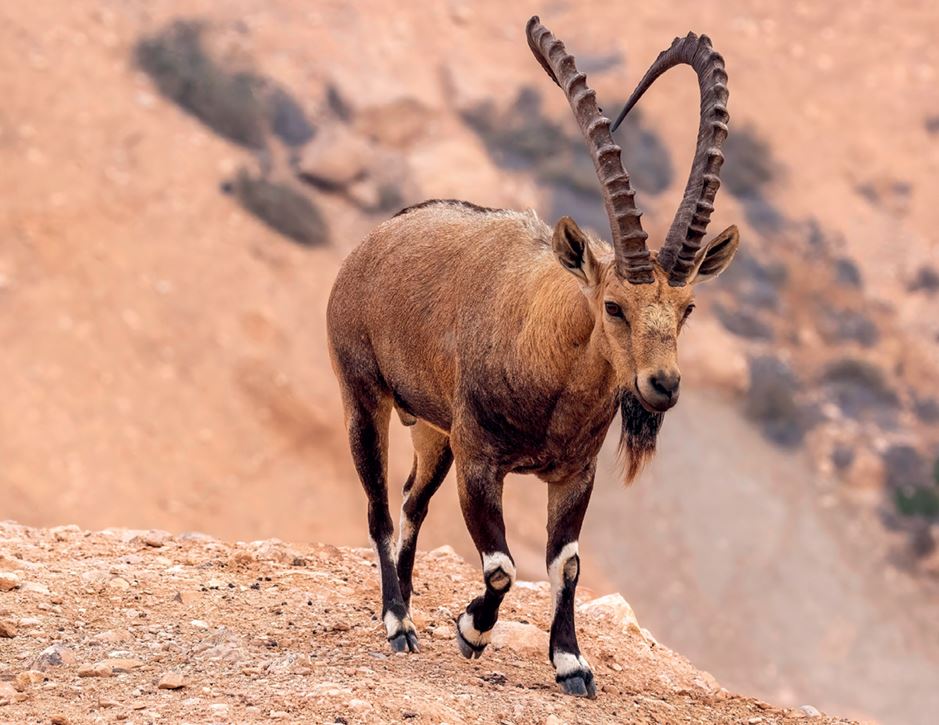
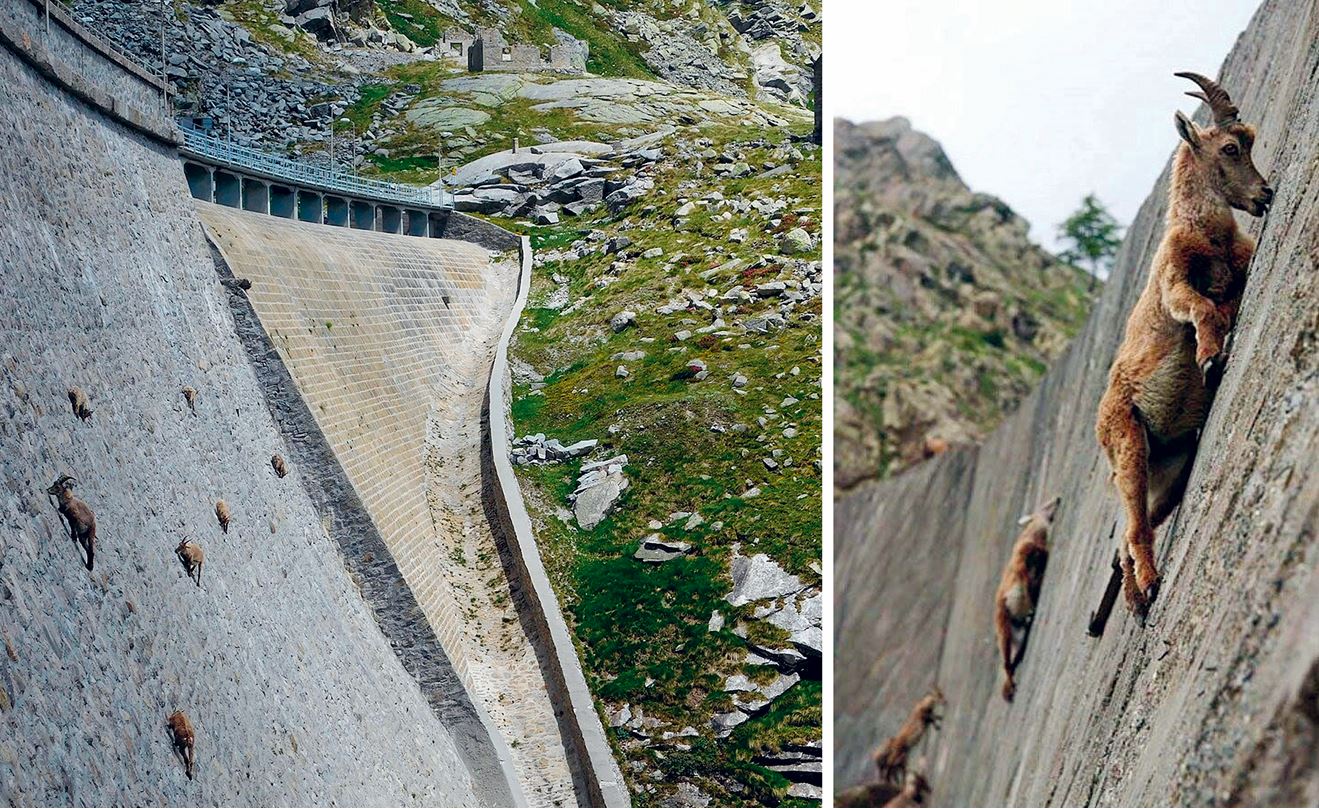
To see a female ibex with her young climbing along a steep cliff is an impressive sight. She is slender and agile – no wonder she is compared to a beautiful woman: « A loving doe, a graceful deer – may her breasts satisfy you always, may you ever be intoxicated with her love.» (Prov 5:19). She always remains close to her offspring, yet she cannot help them on the cliff face. There they are entirely on their own, must find their own way, and quickly become independent. «Their young ones grow strong, they grow up in the open; they go out and do not return to them» (Job 39:4).
«The high mountains belong to the wild goats» (Ps 104:18) – their incredible sure-footedness and climbing ability are the outstanding characteristics of ibex and goats. This is related to the special anatomy of their broad and flat hooves, more precisely to their underside, the sole of the hoof. The outer edges of the hooves consist of hard horn. With these, the gifted climbers can hook onto tiny irregularities and ledges and pull themselves upward or find a secure foothold. In combination with the soft pad inside, which molds itself like a kind of putty to irregularities in the rocky ground and increases friction, the animals can overcome almost all inclines and substrates found in the mountains. Whether gravel, coarse scree, steep slopes of bare rock, muddy, wet, or even icy paths – they are equal to all challenges.
But they are not only good climbers. Thanks to their powerful leg muscles, they can leap vertically upward from a standstill by up to two meters, and with sufficient run-up they can seemingly effortlessly jump from one side of a ten-meter-wide gorge to the other. Since their spine and legs are very light and elastic, they can withstand a fall onto hard rock from a height of five to six meters without breaking bones.
Sources:
Biancardi, CM; Minetti, AE: Climbing dam walls: new habits for the Alpine ibex? Hystrix – Italian Journal of Mammalogy 2014; 25 (Supplement, p. 18) – IX Congresso Italiano di Teriologia
Fehilly, C; Willadsen, S; Tucker, E: Interspecific chimaerism between sheep and goat. Nature 1984; 307:634-636; doi.org/10.1038/307634a0
Iribarren, C; Kotler, BP: Foraging patterns of habitat use reveal landscape of fear of Nubian ibex Capra nubiana. Wildlife Biology 2012;18:194-201; doi: 10.2981/11-041
Tadesse, SA; Kotler, BP: Seasonal habitat use by Nubian Ibex (Capra Nubiana) evaluated with behavioral indicators. Israel Journal of Ecology & Evolution 2011; 57(3); doi: 10.1560/IJEE.57.3.223
Image Credits:
Wikipedia: 3 ibex / אהוד הלפרין // Ibex on dam wall / Claudio Bedin
other licenses: Title – Mouflon / shutterstock ID_1373640584 / Kikkia Jackson // Mouflon portrait / shutterstock ID_1803218089 / Susanne Edele // Nubian ibex / shutterstock ID_2225483011 / Luciano Santandreu // Bezoar goat / shutterstock ID_1426356836 / karpetrosian