Although hippopotamuses were formerly widespread across large parts of Western Asia (and even Europe), they have long been extinct in the Middle East. In Israel they probably no longer existed even at the time of the conquest, although they may have been known to the Israelites from Egypt, where they were not eradicated until the beginning of the 19th century. They are also increasingly disappearing from German Bible translations …
European travelers first encountered the only surviving species of the genus Hippopotamus, the common hippopotamus (Hippopotamus amphibius), in Egypt and accordingly called it «Nile horse», a designation that has persisted to this day. Since the first scientific description in 1758, drawings of the animal also circulated in Europe. The massive physique of these animals, which can sometimes reach a weight of over two tons, and especially their enormous dentition with tusk-like canines, stimulated the imagination, making them a popular subject for illustration.
Scholars early on associated these colossi – known to them only from reports – with the biblical description of the Behemoth (Job 40:15–24). The first written evidence of this identification is found in the work Hierozoicon (1663) by Samuel Bochartus. In Russian and Ukrainian, the term «Behemot» (Бегемот) even became the common word for the hippopotamus. However, there is no extrabiblical evidence that this word was ever used for the hippopotamus in Hebrew or Aramaic. The corresponding Arabic expression «Bahīmūth» or «Bahamūt» does refer to a (fish-like) monster, but by no means to the hippopotamus.
Since that time, when little was known about exotic animals, many translators adopted the identification of the hippopotamus with the Behemoth of Job 40:15. In some translations it can still be found in current editions: for example in the Gute Nachricht Bibel (GN, 2018), Einheitsübersetzung (Einh, 2016), and Neues Leben Bibel (NLB, 2017). In most cases, however, it was corrected in later revisions. Thus, the hippopotamus appears in Hermann Menge’s text version of 1946, but no longer in the «Menge 2020»; in Schlachter’s 1851 text, but no longer in the «Schlachter 2000»; and in the Zurich Bible up to 1931, but not in the 2007 edition.
Many translators, however, assumed from the outset that the described animal could not be identified with any species living today and therefore chose to leave the Hebrew term «Behemot(h)» untranslated (as in the Luther Bible, Elberfelder Bible, Neue evangelistische Übersetzung, and Hoffnung für alle).
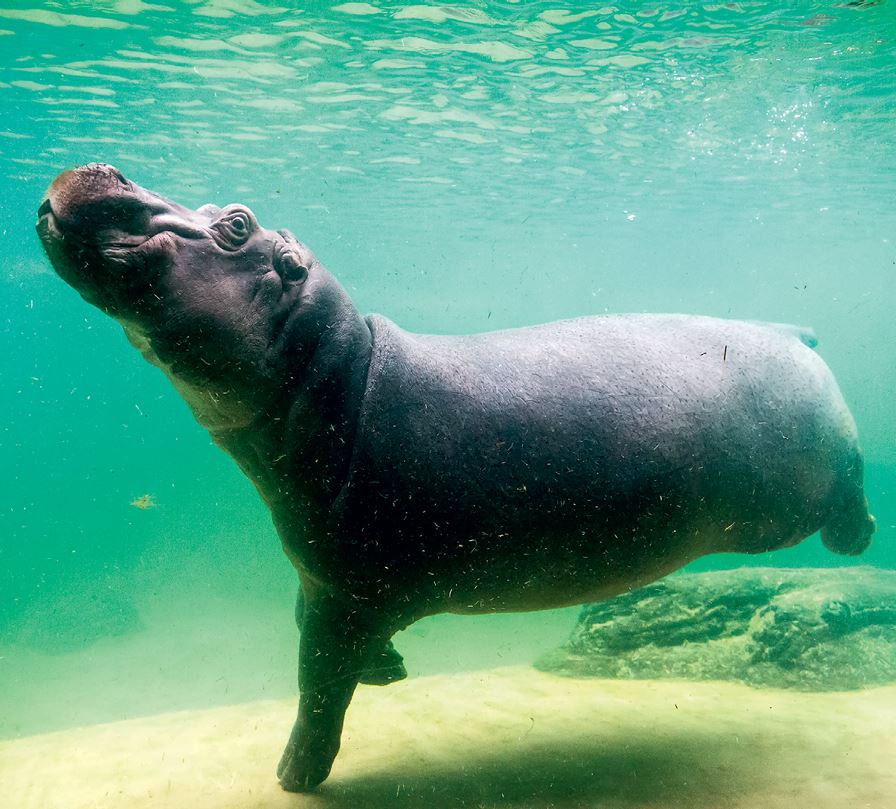
The round, chubby animals with their good-natured, grinning faces and the cute nickname «Hippo» are endearing to most people. When they surface from the water snorting and shake the water from their protruding ears with quick twisting motions, or lie flat on their bellies, all four legs stretched out, reddish and gleaming as they doze in the sun, one cannot help but smile.
Yet one must not forget that they are aware of their ability to defend themselves and – at least the dominant bulls – «think territorially». Their stretch of river is their territory, and every intruder is driven away. Hair-raising stories circulate about the dangerousness of hippopotamuses. It is sometimes claimed that more people fall victim to their tusks than to the fangs of lions. However, no worldwide statistics are kept for «wildlife accidents», and most figures are based on estimates. There are, however, individual studies in which exact data were collected, as shown in the illustration.
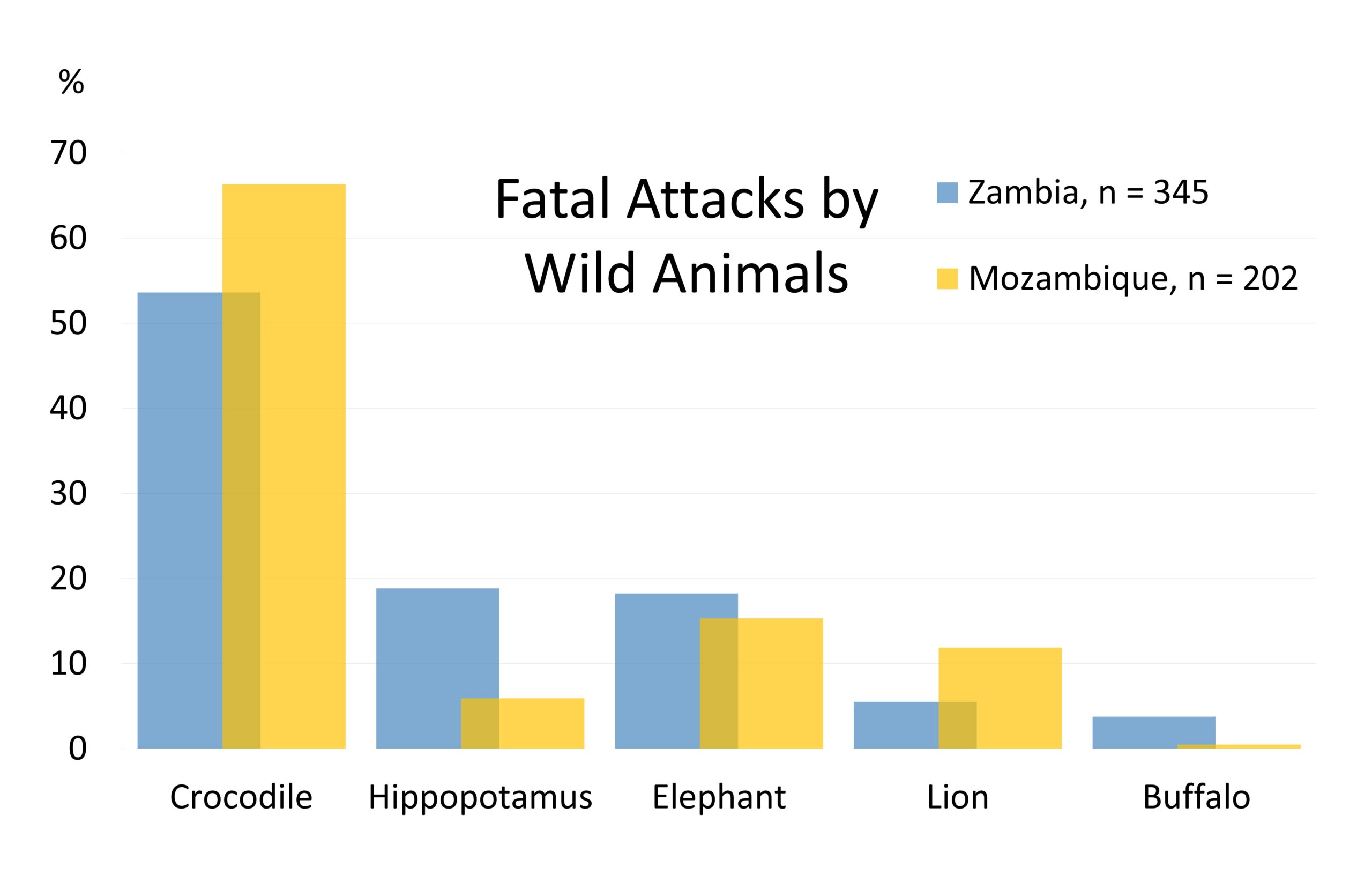
While Zambia, a country with extensive lake and swamp regions, hosts the largest hippopotamus population in the world, neighboring Mozambique – also situated along the Zambezi River but predominantly savanna – has proportionally more other species of dangerous wild animals. Since hippopotamuses occur only in a few water-rich regions of Africa and most of the continent is covered by dry savannas and deserts, the data from Mozambique more clearly represent the overall situation. Even if their dangerousness may sometimes be somewhat exaggerated, both rankings show clearly that caution is required around them.
Much has been written over the centuries about the question of the identity of the Behemoth. Two studies listed in the bibliography provide a good overview. Particularly recommended is the book «The Mystery of the Leviathan». Since among the many proposed solutions only the hippopotamus identification found its way into German-language Bible translations, we confine ourselves to it here.
The hippopotamus is a peacefully grazing herbivore that can turn into a deadly threat in the blink of an eye – at first glance, this characterization fits the Behemoth in Job 40:15 exceedingly well. It was probably still widespread in the Near East in Job’s time. How do the other characteristics compare?
«What strength it has in its loins, what power in the muscles of its belly! Its bones are tubes of bronze, its limbs like rods of iron.» (Job 40:16,18) – Hippopotamuses are indeed remarkably strong and fast. Their massive skeletal structure results in an unusually high specific weight and the notable fact that, although they spend most of their time in water, they cannot swim and will sink even with filled lungs.
«He makes his tail stiff like a cedar» (Job 40:17a) – The verb translated here as «makes stiff» occurs only at this single location and is also rendered as «carry, move, stretch out, let hang». It cannot be determined more precisely. But apart from that, no one has yet found a meaningful point of comparison between the cedar – a mighty conifer – and the stubby brush-like tail of the hippopotamus. It sometimes spins it like a small propeller and distributes its excrement to mark its territory.
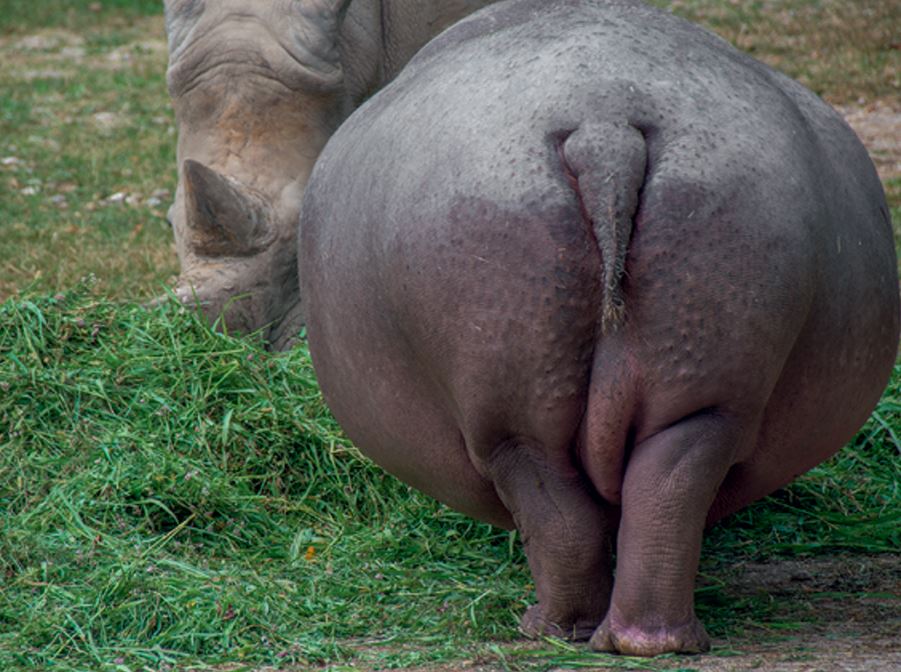
«The sinews of his thighs are knit together» (Job 40:17b) – In this respect, no anatomical peculiarities have been observed in the hippopotamus. In terms of musculature and tendon structure, they correspond to other large herbivores.
«It ranks first among the works of God» (Job 40:19a) – This sounds like a superlative. One would expect God to describe the Behemoth as the most impressive animal (among herbivores) known to Job, followed by Leviathan as the strongest and most dangerous predator. Depending on the chronological and geographical placement of the book of Job and on assumptions about earth history, these could indeed have been the hippopotamus and the crocodile.
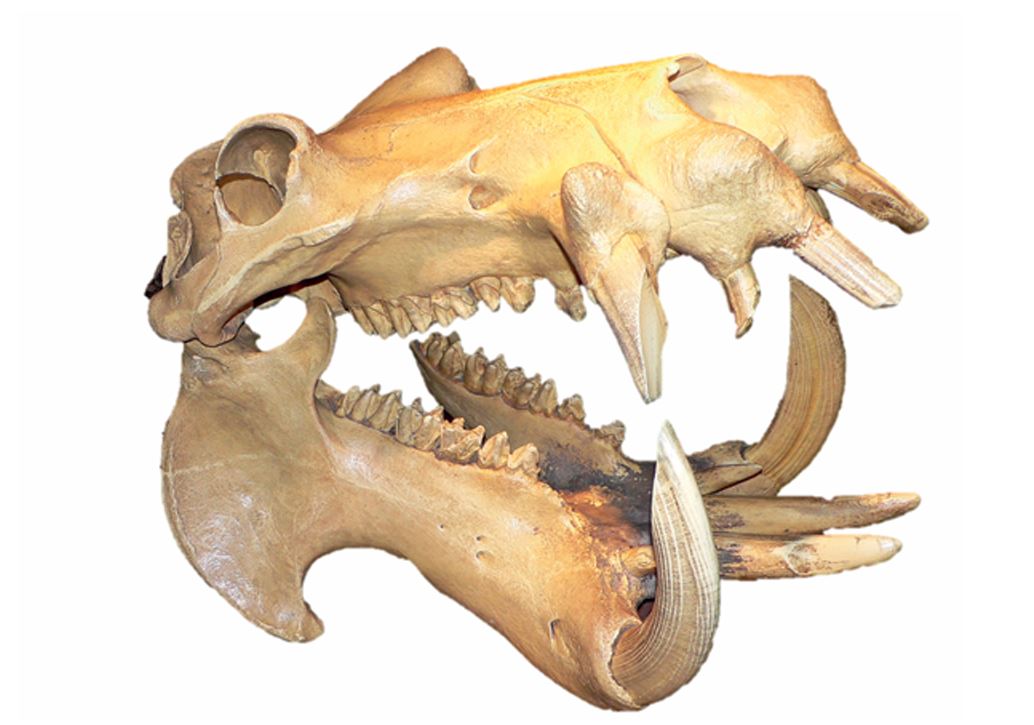
«He only that made him giveth him his sword» (Job 40:19b) – The large tusks are a striking feature and must not be missing from a description of the hippopotamus. In a poetic text, they could possibly be referred to as a «sword».
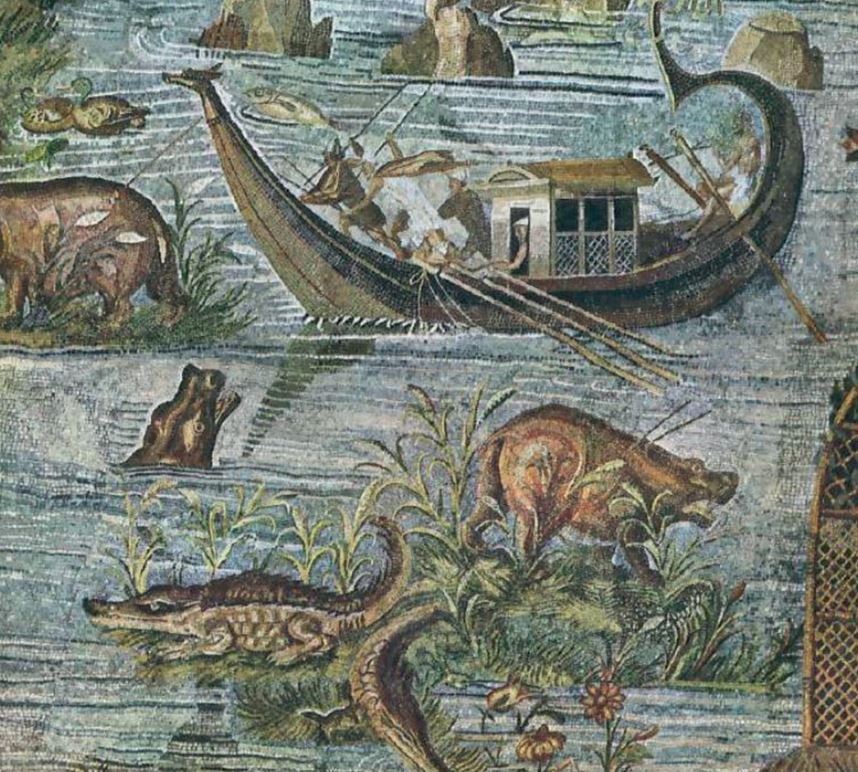
«The hills bring it their produce, and all the wild animals play nearby. Under the lotus plants it lies, hidden among the reeds in the marsh. The lotuses conceal it in their shadow; the poplars by the stream surround it. A raging river does not alarm it; it is secure, though the Jordan should surge against its mouth» (Job 40:20–23) – Modern hippopotamuses generally graze in plains and river valleys and avoid steep inclines. In that respect, «the mountains» seem somewhat out of place here, but otherwise the description fits excellently. The white lotus blossoms are even depicted on the ancient «Nile Mosaic of Palestrina».
«Can anyone capture it by the eyes, or trap it and pierce its nose?» (Job 40:24) – This is another major weakness. In his speech (Job 38–41), God poses more than seventy rhetorical questions to Job; this is one of them. The statement is: you are not able to «put the Behemoth on a leash». The fact is, however, that hippopotamuses (like crocodiles) have been successfully hunted since earliest times (and almost everywhere exterminated). Despite their strength and aggressiveness, they are not invincible. They cannot follow their hunter into deep water and are not particularly clever.
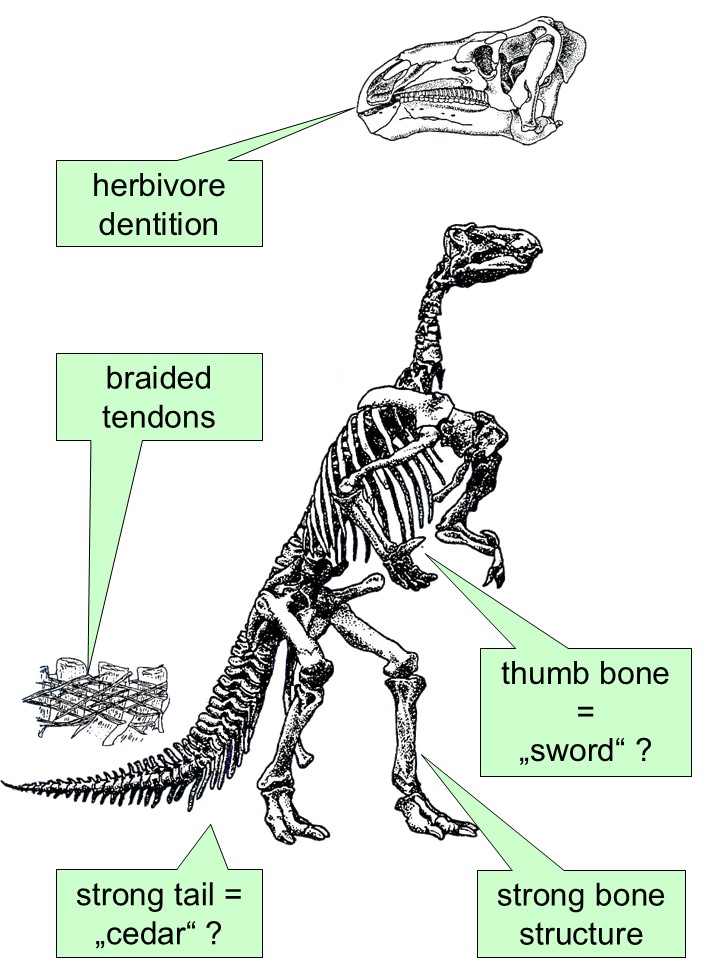
Although the comparison yields mixed results, among animals living today the description fits the hippopotamus best. The picture changes when extinct species are included. The «Schlachter 2000» adds a helpful note to Behemoth: «The description points to a plant-eating saurian, not, as previously assumed, to the hippopotamus.»
Sources:
Ahuis, F: Behemoth, Leviathan and the Human Being in Job 38–42. Zeitschrift für die Alttestamentliche Wissenschaft (ZAW 123) 2011; pp. 72–91; doi: 10.1515/ZAW.2011.006
Bochartus, S: Hierozoicon, Sive Bipertitum Opus De Animalibus S. Scripturae (Vol. 1, p. 77). Leiden, NL (Boutesteyn & Luchtmans) 1692; https://transkribus.eu/r/noscemus/#/documents/725075/pages/77
Chomba, C; Senzota, R; Chabwela, H: Patterns of human–wildlife conflicts in Zambia, causes, consequences and management responses. Journal of Ecology and the Natural Environment 2012; 4(12):303–313; doi: 10.5897/JENE12.029
Dunham, KM; Ghiurghi, A; Cumbi, R: Human–wildlife conflict in Mozambique: a national perspective, with emphasis on wildlife attacks on humans. Oryx – The International Journal of Conservation 2010; 44(2):185–193; doi: 10.1017/S003060530999086X
Fox, MV: Behemoth and Leviathan. Biblica 2012; 93:261–267
Hartmann, F: The Mystery of the Leviathan (pp. 29–39). Berneck (Schwengeler) 1994
Mackey, DF: Monsters in the Book of Job. AMAIC, Australian Marian Academy of the Immaculate Conception; https://www.academia.edu/78946743/Monsters_in_the_Book_of_Job?email_work_card=view-paper
Meder, A; Diener-Steinherr, A; Oschatz, S: Living Wilderness – Animals of Rivers and Streams (Hippopotamuses, pp. 7–25). Stuttgart (Das Beste) 1994
Maydana, SF: Hippopotamus hunting in Predynastic Egypt: Reassessing archaeozoological evidence. Archaeofauna 2020; 29:137–150; doi: 10.15366/archaeofauna2020.29.009
van Houdt, S; Traill, LW: A synthesis of human conflict with an African megaherbivore: the common hippopotamus. Frontiers in Conservation Science 2022; 3:954722; doi: 10.3389/fcosc.2022.954722
Paul, MJ: Behemoth and Leviathan in the book of Job. Journal of Creation 2010; 24(3):94–100
Image Credits:
Wikipedia: Hippopotamus skull / Raul654 // Hippopotamus hunt / WolfgangRieger
other licenses: Hippopotamus in water / Shutterstock ID_418437226 / Sergey Uryadnikov // Hippopotamus on riverbed / Shutterstock ID_470934629 / Lena Ivanova // Hippopotamus tail / Shutterstock ID_791640805 / Jana Alfares